
Under Malaysia's 2025 breach rules, a serious data breach must be reported within 72 hours. That clock starts once you learn of or confirm the breach, even before your team has the full story. So the real test comes in those first three days. Can your systems show what was taken, whose data it was and how it got out?
This guide explains what a data breach is in plain words. It covers how breaches happen, what they cost and the reporting rules in Malaysia, Singapore and Australia. It ends with what your own software should record. That record keeps a bad day from turning into a bad year.
Key takeaways
- A data breach is when personal data is lost, misused or opened by someone without permission. It can be an attack, a mistake or a lost laptop.
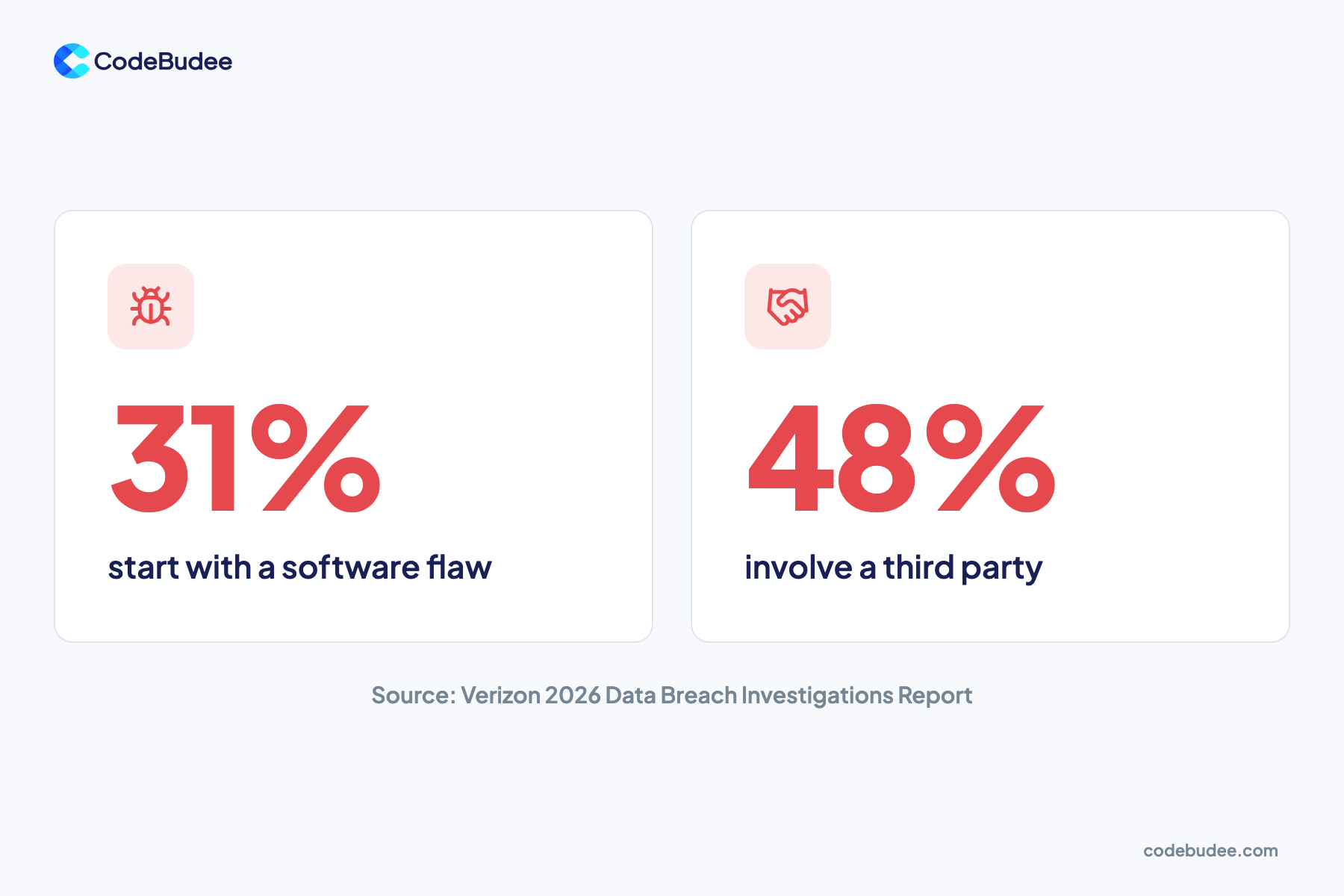
- In 2026 reports, 31% of breaches started with a software flaw and 48% involved a third party.
- Malaysia gives you 72 hours to tell the Commissioner and 7 more days to tell affected people. Singapore gives 3 calendar days once you know it must be reported.
- Your systems should log who opened which records, limit access by role and alert you to odd activity. Without that, you cannot answer the regulator's questions in time.
What is a data breach?

A data breach is when personal data you hold is opened, copied, lost or misused without permission. Hacks count. So does an email sent to the wrong person. A stolen laptop or a staff member taking a customer list counts too. If people's data left your control, treat it as a breach.
Malaysia's Personal Data Protection Act covers any breach, loss or misuse of personal data. It also covers access without permission. How the data escaped does not change the rules.
People also ask about a data breach vs a data leak:
- Data leak: data left open by mistake, such as a public link or an unlocked database.
- Data breach: the wider term. It includes leaks, attacks, theft and misuse by insiders.
Bottom line: for the reporting rules, the label does not matter. What matters is whose data was exposed and how much harm it could cause.
How do data breaches happen?
Many breaches start in ordinary places. Think of an old software flaw nobody fixed, a supplier with access to your systems, or a stolen password. Attackers look for the easiest open door. AI tools now help them find and use those doors faster, in hours rather than months.
Reports from 2026 show where those doors are:
- Software flaws: Verizon's 2026 Data Breach Investigations Report found that 31% of breaches started by exploiting a software flaw.
- Third parties: 48% of breaches in the same report involved a third party, such as a supplier.
- AI-assisted attacks: IBM's 2026 study of 602 organisations found one in four malicious breaches were AI-enabled. That was up 56% on the year before.
Australia's regulator sees a similar pattern. In 2025, it received 1,205 breach reports. Of those, 716 came from malicious or criminal activity, says the Office of the Australian Information Commissioner.
So fix known software flaws and check what your suppliers can reach. We cover the basics a young system needs in what to fix before an MVP meets real users.
What does a data breach cost a business?
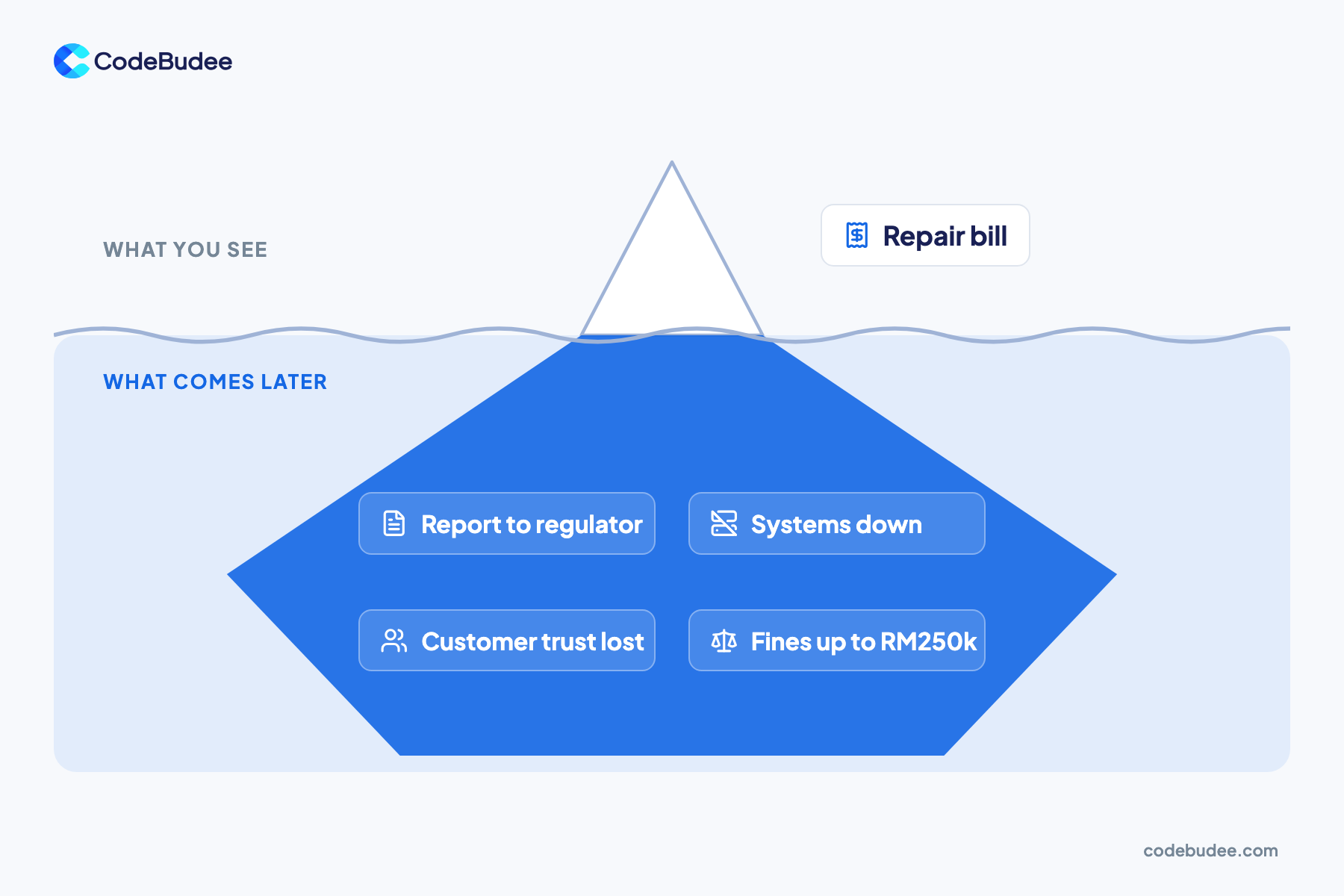
Breach costs go far beyond the repair bill. The IBM Cost of a Data Breach Report 2026 puts the global average at USD 4.99 million. That is a 12% rise on the year before and a record high.
That figure is a global average, so your number will differ. But the same costs show up at every size:
- Reporting work: finding out what was taken, writing to the regulator and contacting each affected person.
- Downtime: systems taken offline while you find and close the gap.
- Lost trust: customers who move to a rival after getting your breach notice.
- Fines: in Malaysia, failing to report can mean a fine of up to RM250,000. It can also mean up to two years in jail, or both.
These costs grow with time. Slow answers mean longer downtime. They also mean more people to contact.
What must you do after a data breach in Malaysia, Singapore and Australia?
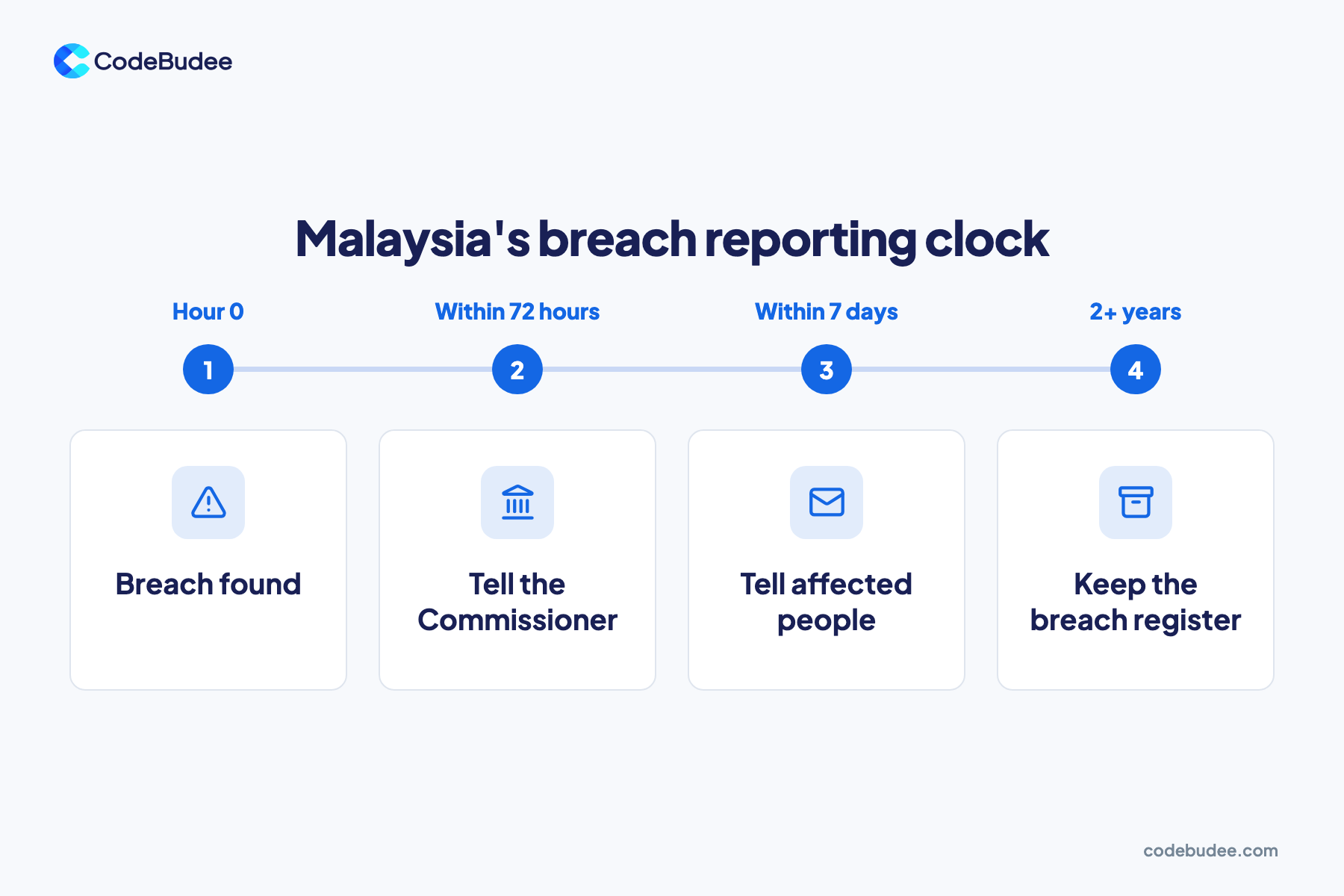
All three countries expect you to report serious breaches to a regulator and to tell the people affected. Malaysia gives 72 hours to tell the Commissioner. Singapore gives 3 calendar days once you know the breach must be reported. Australia expects notice when a breach is likely to cause serious harm.
Malaysia
Malaysia's Personal Data Protection Commissioner's breach notification guideline sets out these steps:
- Tell the Commissioner within 72 hours of the breach, if it causes or may cause significant harm.
- Tell the affected people no later than 7 days after you notify the Commissioner.
- Treat over 1,000 affected people as "significant scale", which must be reported.
- Keep a breach register for at least two years, including breaches you did not need to report.
Singapore
Singapore has the Personal Data Protection Commission (PDPC). Its guide on managing data breaches gives you up to 30 calendar days to assess a breach. Once you find it must be reported, you have 3 calendar days to notify the PDPC. A breach affecting 500 or more people must be reported.
Australia
Australia's Notifiable Data Breaches scheme applies when a breach is likely to cause serious harm. You must then notify the regulator and the people affected.
Can your systems tell you what was taken within 72 hours?
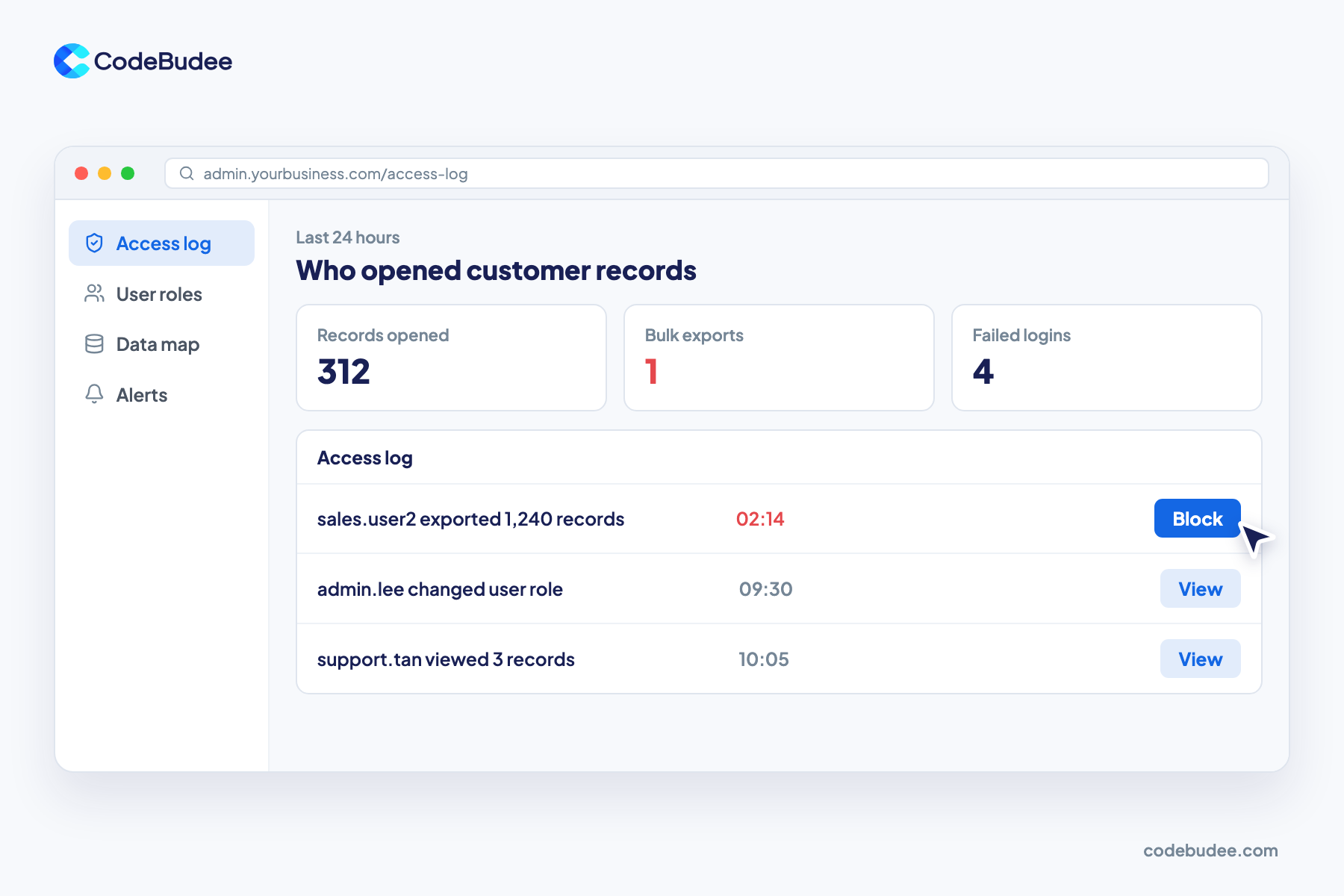
Only if they were built to record it. To report a breach, you must know which data was exposed, whose it was, when it happened and how. A system that logs every access and limits who can see what can answer those questions in hours. Without that record, your team is guessing.
Ask your team whether your current systems can answer these five questions today:
- What data was exposed? Names, IC numbers, bank details, health records?
- Whose data was it? A list of affected customers or staff, with contact details.
- When did it start? The first odd login or export, with a time stamp.
- How did it get out? Which account, which supplier, which device.
- Is it still open? Can you cut off the account or supplier right now?
If the answer is "we would have to check by hand", that is your gap. An Excel file passed around by email cannot tell you who copied it. A rented tool may keep only short logs, or none you can export.
So build the record into your software from the start:
- Access log: every view, edit and export of personal data, tied to a named user.
- Roles: staff see only the records their job needs.
- Alerts: a warning when someone exports far more records than usual.
- Supplier list: which vendors can reach which data, written into their contracts.
For older systems that can't log any of this, it can make sense to replace them. A custom web app development project can put the access log, roles and alerts in from day one. Cloud hosting also helps with backups and recovery, as covered in how cloud-based systems protect your business.
Frequently asked questions
Is a data leak the same as a data breach?
Not exactly. A data leak usually means data left open by mistake, like a public link. A data breach is the wider term and also covers attacks, theft and insider misuse. For Malaysia's reporting rules, the label does not matter. What counts is whether personal data was lost, misused or opened without permission. Then ask how much harm it may cause.
Do small businesses in Malaysia have to report a data breach?
It depends on harm, not company size. Under the Commissioner's guideline, you must report a breach that causes or may cause significant harm. A breach affecting more than 1,000 people counts as significant scale. So a small business with a large customer list can still fall under the rule. If you are unsure, get legal advice early.
If our software vendor is breached, is it still our problem?
Yes. In Malaysia, the reporting duty sits with you as the data controller, not your vendor. The controller is the business that owns the data. Under the guideline, your contracts must oblige vendors to tell you about a breach quickly. Your 72 hours start when the vendor tells you or when you find clear proof, whichever comes first. If your vendor won't answer basic questions, see signs it's time to move on from your developer.
What should we do in the first hour after finding a breach?
Stop the damage first. Lock the affected accounts, change passwords and cut off any supplier access involved. Keep every log and do not wipe affected machines, because you will need that evidence. Write down when and how you found the breach. Then bring in the person who knows the system best, and get legal advice on your reporting duty.
Your next step
Any loss, misuse or unauthorised opening of personal data is a breach. The causes are often ordinary: an unpatched flaw, a supplier, a stolen password. Malaysia's reporting clock is 72 hours. Singapore allows 3 calendar days once a breach is found to be reportable. Whether you meet it depends on what your systems recorded before the breach.
If you are not sure your systems could answer the five questions above, now is the time to check. Book a free consultation to talk through what your systems record today and what they should.
