
Your board wants AI that knows your business. Someone suggests training your own AI model on company data. It sounds like the safe, serious choice. It is also the most costly way to get there, and often the wrong one.
There are three common ways to put AI to work on your own data. You can train a new model or fine-tune an existing one. Or you can use RAG to let the AI look things up. This guide explains each one in plain words. It shows what each costs, where each one fits, and what makes the answers safe for staff to trust.
Key takeaways
- Training your own AI model from scratch costs millions and needs huge amounts of data. Few companies outside AI labs need it.
- Fine-tuning changes how an existing model behaves on a set task. Examples are sorting tickets or writing in a fixed format.
- RAG lets an existing model look up your own files before it answers. Answers stay current and can show their sources.
- RAG still gets things wrong at times. Staff can trust it only with access rules, visible sources and regular answer tests.
- Use RAG when staff need facts and fine-tuning when a model must behave a set way. Almost nobody needs a new model.
What is the difference between training, fine-tuning and RAG?
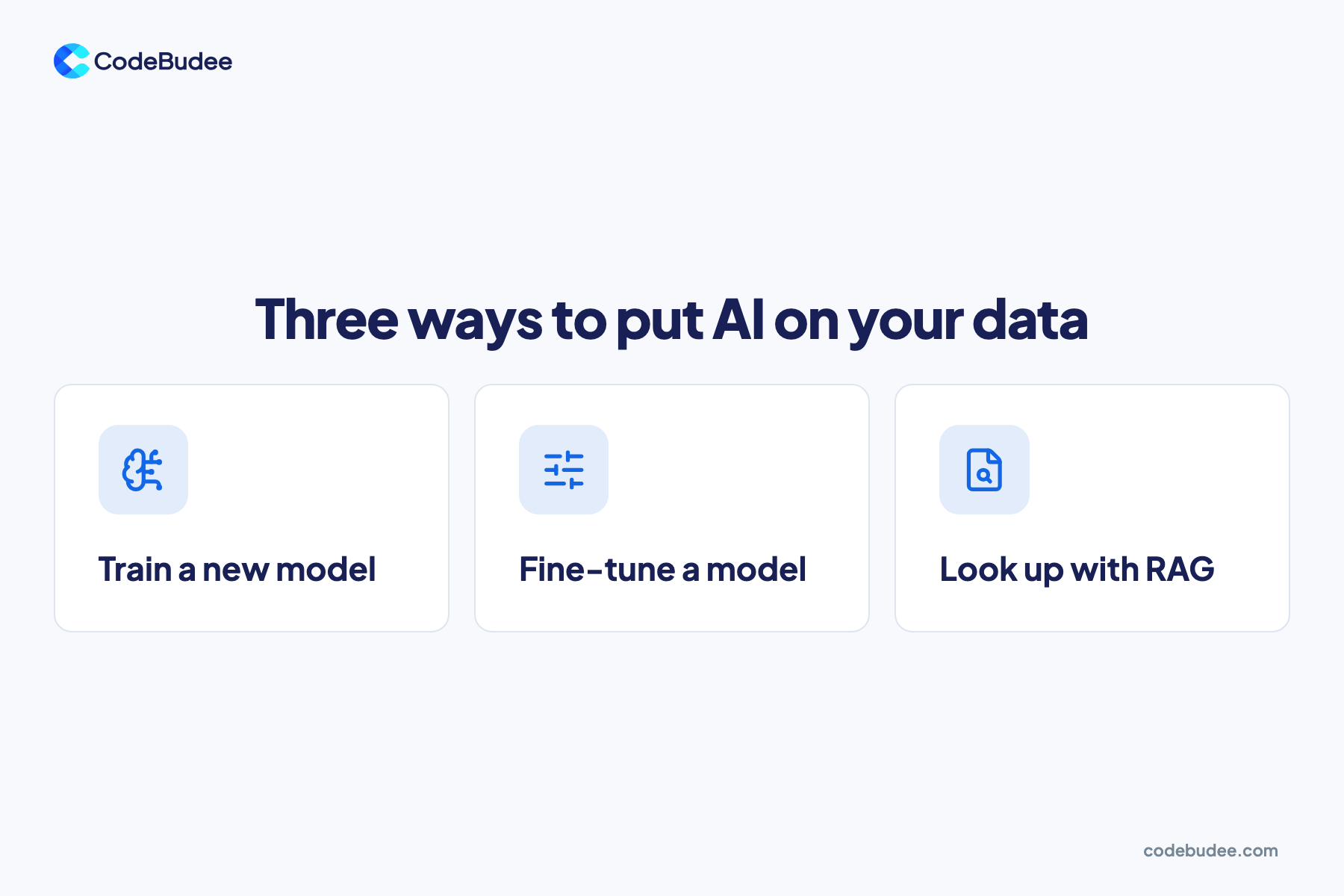
Training builds a new AI model from nothing, using a huge pile of text. Fine-tuning takes a model that already exists and teaches it a narrow skill with your examples. RAG, short for retrieval-augmented generation, leaves the model unchanged. It searches your files for the right passages, then answers from them.
All three use a large language model, the kind of AI behind ChatGPT. The difference is where your company knowledge lives:
- Train a new model: your knowledge is baked into a model you own and run.
- Fine-tune a model: your examples adjust an existing model, mainly how it responds.
- Look up with RAG: your knowledge stays in your own files and systems. The AI reads the relevant parts each time someone asks.
That last point matters most. With RAG, updating a document updates the answers. With the first two, the model only knows what it saw during training.
Should your business train its own AI model?

Almost certainly not. Training a model from scratch needs rare skills and computing power that can cost millions. It also needs far more text than most companies hold. For most firms, a strong existing model plus your own data works better, and costs far less.
Costs at the top end show the scale. The Stanford AI Index 2024 estimates GPT-4 used about $78 million of computing power to train. Google's Gemini Ultra cost an estimated $191 million.
A model built for one industry is smaller, yet still large. Bloomberg built BloombergGPT in 2023, a model with 50 billion parameters, or internal settings. It trained on 363 billion tokens of its own finance data, plus 345 billion tokens of general text. A token is a small chunk of a word. Few companies own anything close to that volume of data.
There is also the upkeep. A trained model goes out of date the day training ends. Every new policy, price or product means more training.
When does fine-tuning make sense?
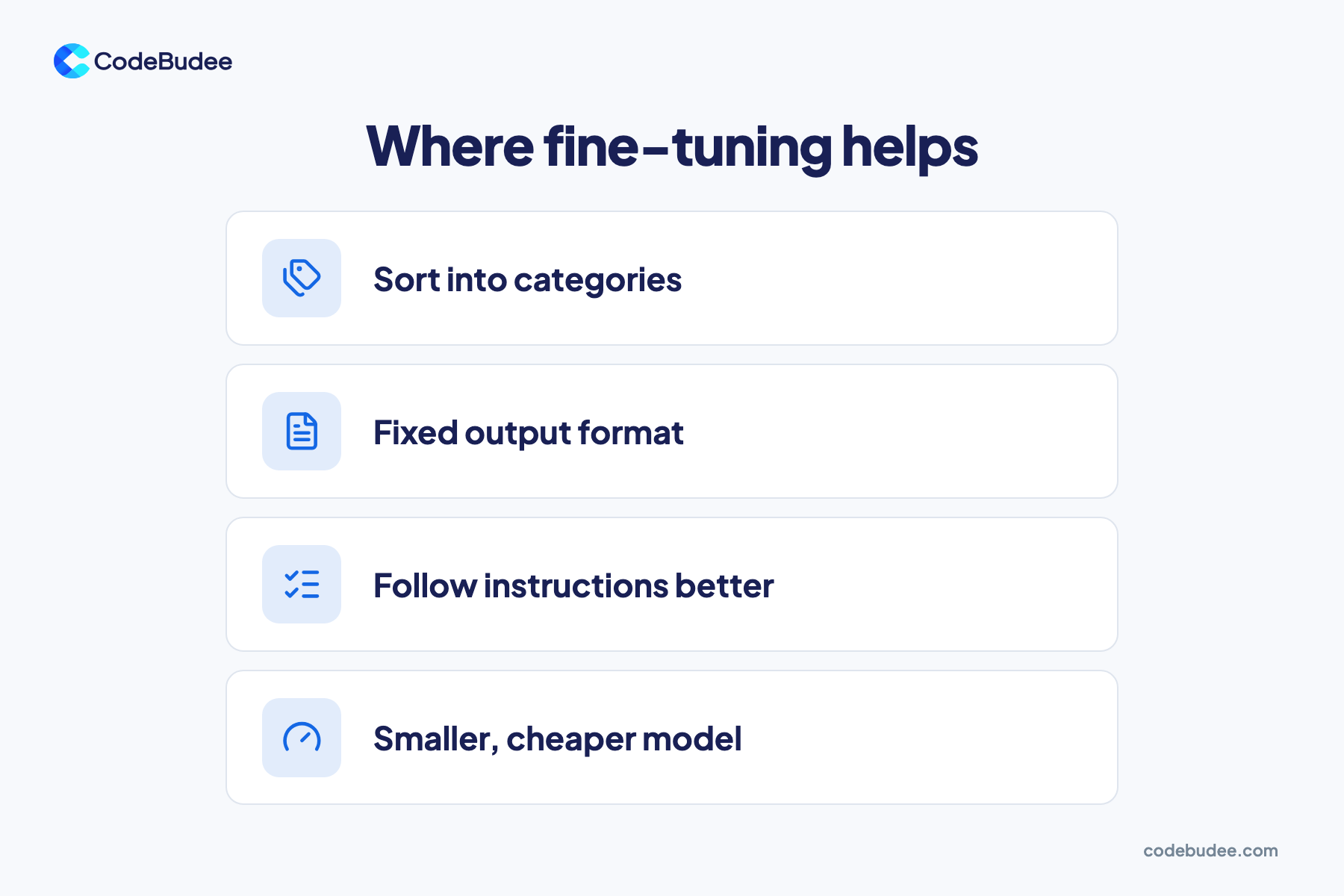
Fine-tuning makes sense when a model must behave in a set way. It can teach a model to sort items into your categories or follow your output format every time. It can fix instructions the model keeps missing. And it can let a smaller, cheaper model do one narrow job well.
OpenAI's model optimisation guide lists uses such as classification, content in a specific format and fixing instruction-following failures. It also notes fine-tuning can train "a smaller, cheaper, faster model to excel at a particular task."
Good examples for a business:
- Sorting incoming support emails into your own ticket types.
- Turning site notes into your fixed report layout.
- Pulling the same fields from thousands of similar forms.
Fine-tuning is less common than many people think. A 2024 Menlo Ventures survey asked 600 US enterprise decision-makers. Only 9% of their models in live use were fine-tuned. Fine-tuning also does not keep facts current. When your price list changes, the fine-tuned model still holds the old one.
Why is RAG the usual choice for company data?
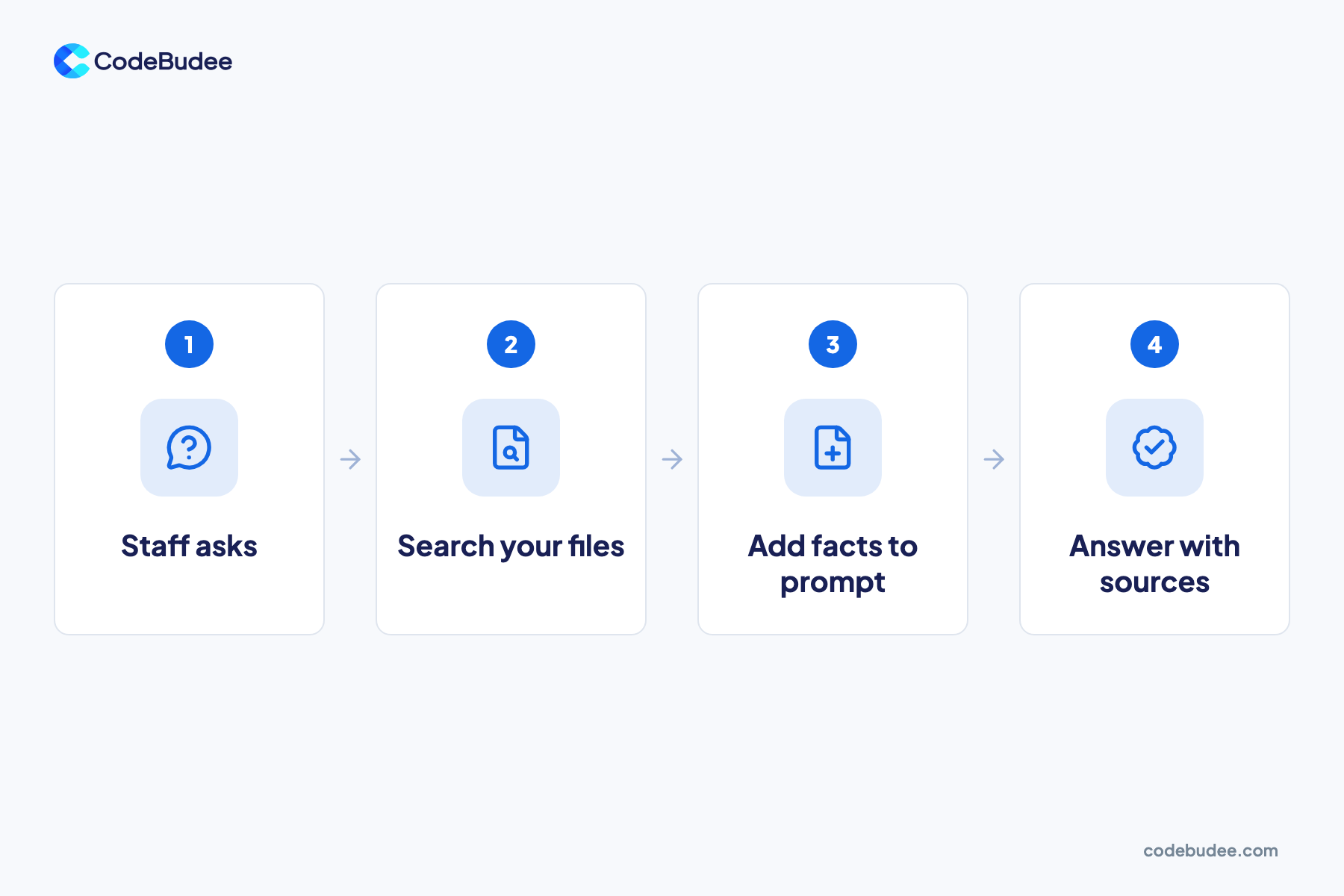
RAG is the usual choice because your answers come from your latest files, not from what a model memorised. When staff ask a question, the system finds the matching passages in your documents. It passes them to the AI. The AI then answers from that text, and can point to where each answer came from.
It works in four steps:
- Staff asks: someone types a question, such as "How many days of annual leave do I get?"
- Search your files: the system finds the most relevant passages in your handbooks, policies or records.
- Add facts to the prompt: those passages go into the prompt with the question. The prompt is the message sent to the AI.
- Answer with sources: the AI writes the answer and links back to the passages it used.
Firms have moved this way fast. The same Menlo Ventures 2024 survey found RAG adoption reached 51%, up from 31% the year before.
The answers can only be as good as the files behind them. Are your files out of date, scattered or full of copies? Then start with our guide to signs your business data is not ready for AI.
What does a RAG system need before staff can trust it?
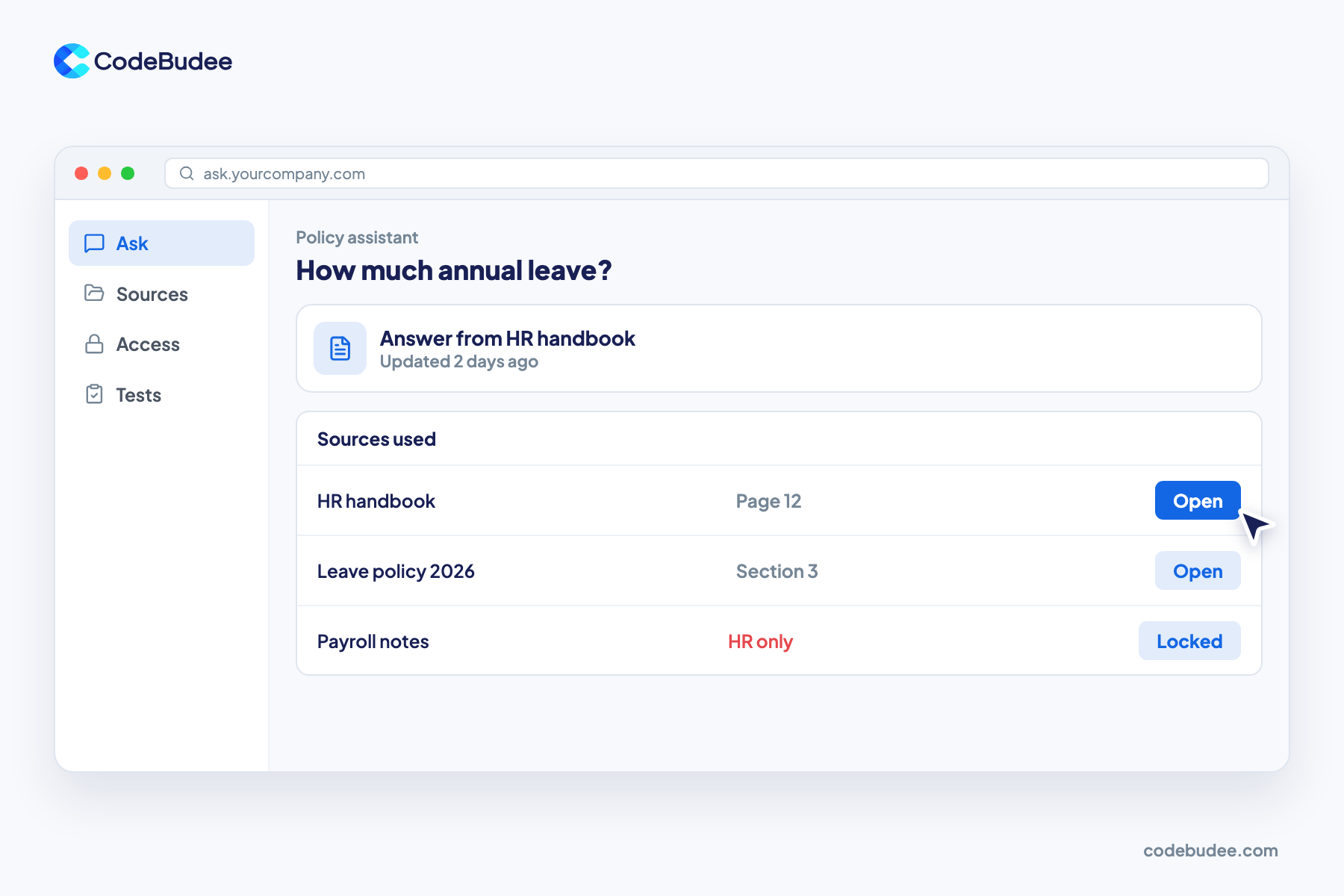
A RAG system staff can trust needs four things beyond the AI itself. It must respect who may see which file. It must show the source behind every answer. It must stay in sync with your latest documents. And it must be tested against real questions with known answers, before launch and after every change.
Looking things up lowers wrong answers but does not remove them. A 2024 Stanford study tested legal research tools built on RAG. Two gave incorrect information more than 17% of the time. One tool did so more than 34% of the time. That is why visible sources matter. Staff can check the passage instead of trusting the answer blindly.
Access is the other big risk. IBM's 2025 Cost of a Data Breach report found 13% of organisations reported breaches of AI models or applications. Of those, 97% had no AI access controls in place.
Before launch, check each of these:
- Access rules: staff only get answers from files they may already open. Payroll stays with HR.
- Visible sources: every answer links to the document and section it came from.
- Fresh data: new and changed files flow in on their own, and old versions drop out.
- Answer tests: a set of real questions with known answers, re-run after every change.
- An owner: one named person or team fixes wrong answers and missing files.
This is mostly normal software work: logins, permissions, data links and testing. That is why a working AI prototype is not yet a system your business can depend on.
How do you choose the right option?
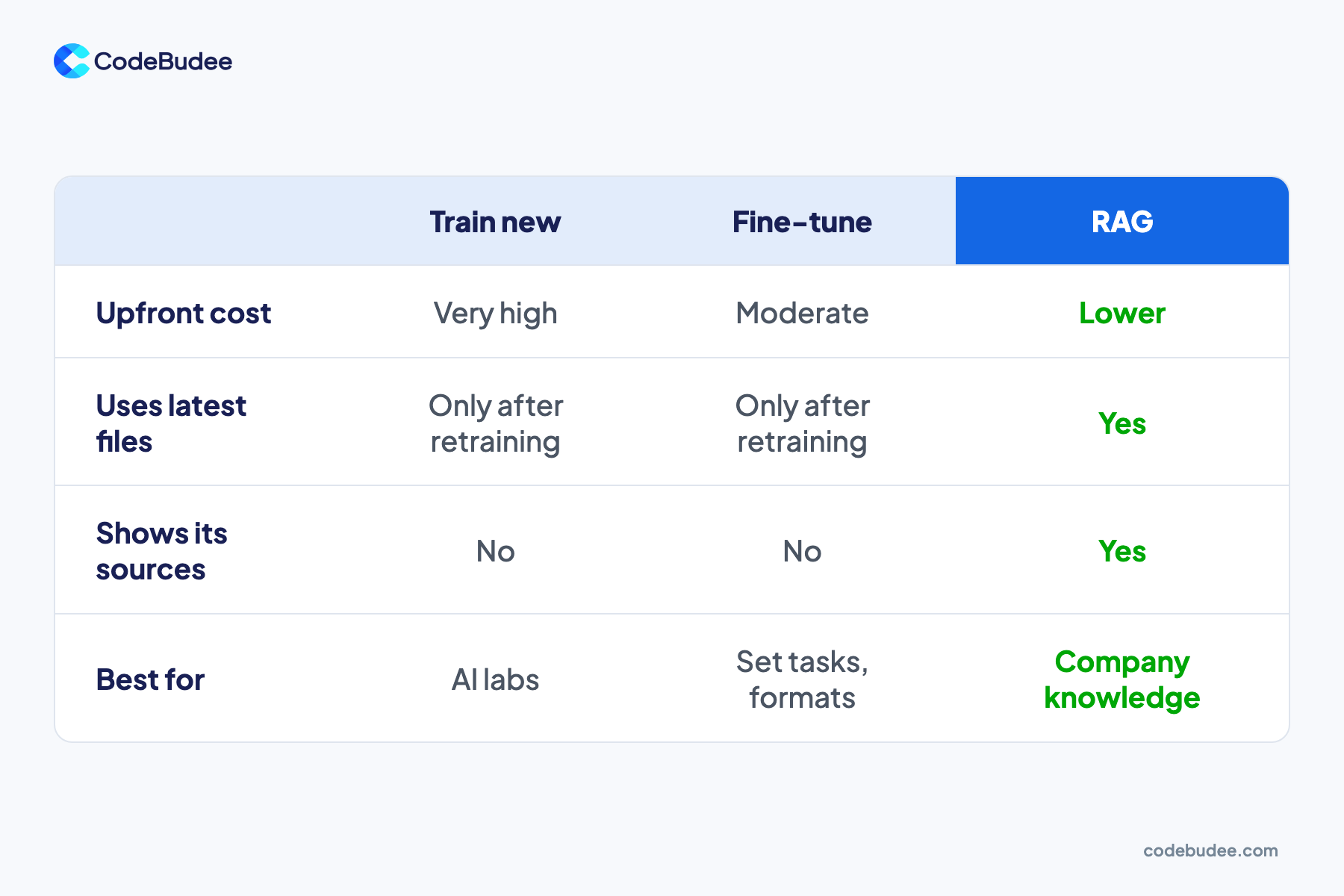
Start with the problem you want solved. If staff need answers from your own documents, use RAG. If a model keeps getting the format or task wrong, consider fine-tuning. Training a new model only makes sense if building AI models is your business. You can also mix both, with RAG for facts and fine-tuning for one narrow task.
Here is how the three compare:
- Train a new model: the highest upfront cost. Learns new facts only when you retrain. Cannot show its sources. Best for AI labs.
- Fine-tune a model: moderate cost. Learns new facts only when you retrain. Cannot show its sources. Best for set tasks and formats.
- Use RAG: lower upfront cost. Uses your latest files. Can show its sources. Best for company knowledge.
Bottom line: pick RAG for company knowledge. Add fine-tuning only for a narrow task RAG cannot handle. Leave model training to AI labs.
Most of the work sits around the AI. That means screens, data links, access rules and tests. That is what custom web app development delivers for an AI-powered system. To see how a build runs from idea to launch, read how the custom software development process works.
Frequently asked questions
Can we use ChatGPT with our own company data?
Yes, through a setup like RAG. Your documents stay in your own storage. The system sends only the passages needed for each question to the model. Pick a business plan that does not use your data for training. Then add your own access rules, so each person only gets answers from files they may already open.
Does RAG stop AI from making things up?
No, but it helps. RAG gives the model the right passages to answer from, which cuts down on guessing. Wrong answers still happen, as the Stanford study of legal tools showed. Visible sources let staff check each answer quickly. Regular tests with known answers catch problems before staff rely on them.
How much does a RAG system cost compared with training a model?
Far less. Training a large model from scratch can cost millions in computing power alone. A RAG system uses an existing model, so most of the cost is building the system around it. That means search, data links, access rules, screens and testing. The final price depends on how many systems and files it must connect. For a wider view, read our cost-benefit guide to custom software.
Should we fine-tune instead of using RAG?
Only if the problem is how the model behaves. Fine-tune when the model keeps missing your format, your categories or your instructions. Use RAG when staff need facts from your documents, because fine-tuning does not keep facts current. You can start with RAG, then fine-tune later for one narrow task.
Your next step
Most businesses do not need their own AI model. They need AI that answers from their own files and respects who can see what. It should also show where each answer came from. Start with one clear problem, such as policy questions or product lookups. Get the data and access rules right, test the answers, then grow from there.
Book a free consultation to talk through which AI approach fits your data and your systems.
