
You fit sensors to your machines, trucks or cold rooms. The readings show up on a supplier's app. Yet nobody acts on them, and staff still type the same numbers into your main system each week.
That gap is where a lot of IoT money is wasted. The sensors work. The data never reaches the systems your team uses to plan, order and fix things.
This guide explains what IoT means for a business in plain words. It shows why so many projects stall after the trial. It also walks through how to get sensor data into your systems, and when to build your own.
Key takeaways
- IoT for business means devices that send readings on their own. Your systems can then act without anyone typing them in.
- Many IoT projects stop at the trial stage, often because the data never joins the rest of the business.
- Sensor data pays off only when it lands in the systems that plan work, raise orders and send alerts.
- Buy a ready platform for simple, standard needs. Build a custom system when the data must drive your own workflows.
- Start with one costly problem and prove the full data path. Secure every device before you scale.
What does IoT mean for a business?
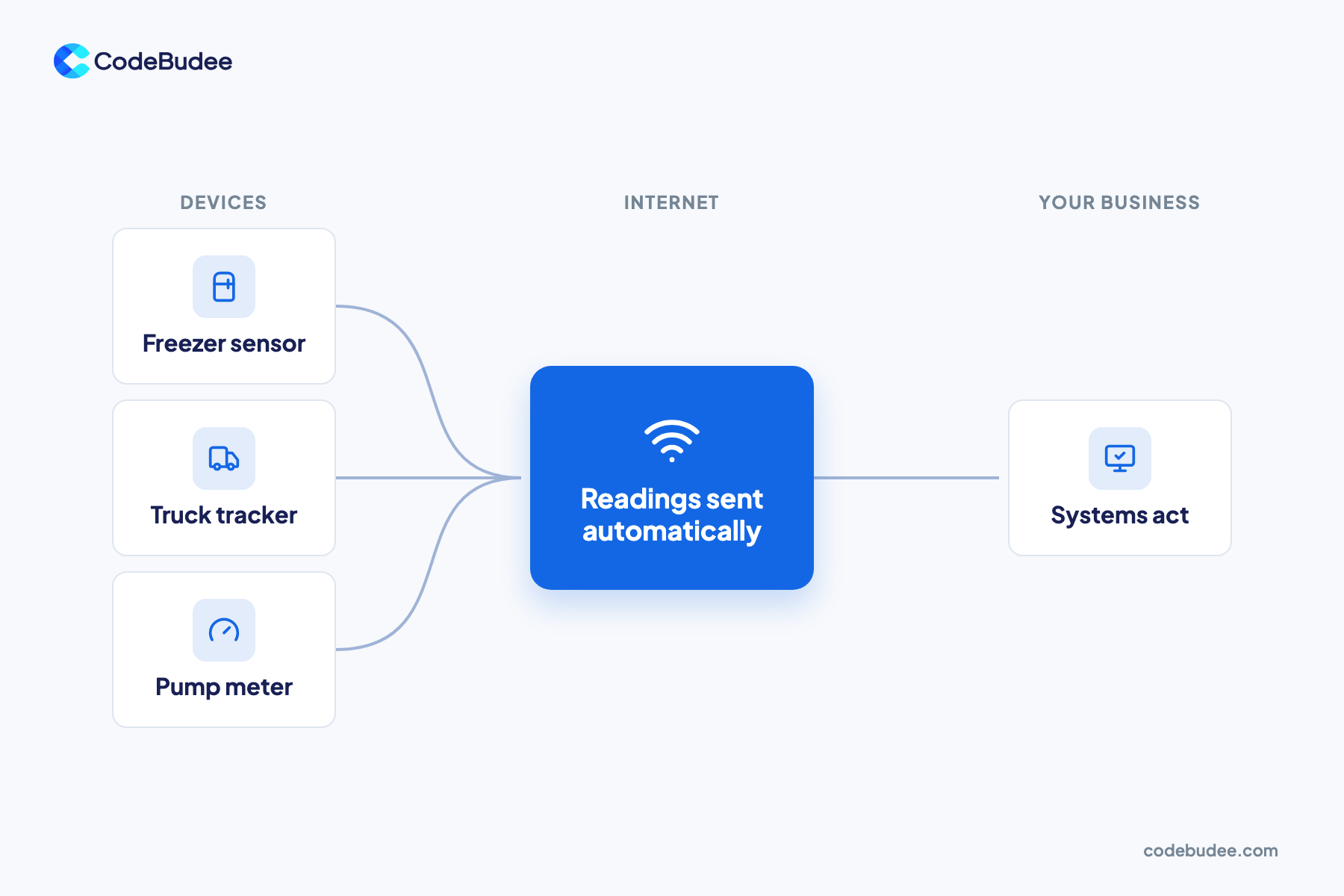
IoT, the Internet of Things, means everyday equipment that measures something and sends the reading over the internet. Think of a sensor on a freezer, a tracker on a truck or a meter on a pump. For a business, the point is simple. Readings arrive on their own, so systems can act without anyone typing them in.
Each sensor is a small device that measures one thing, like heat, shaking or location. Connected devices are now everywhere. IoT Analytics expects 21.1 billion connected IoT devices by the end of 2025. It forecasts 39 billion by 2030.
Business use is still early, though. The Australian Bureau of Statistics found only 6% of Australian businesses used IoT in the year to June 2022. In Singapore, IMDA's 2019 survey found 25% of firms with digital spending put money into IoT. So there is still room to get ahead.
Why do so many IoT projects stall after the pilot?
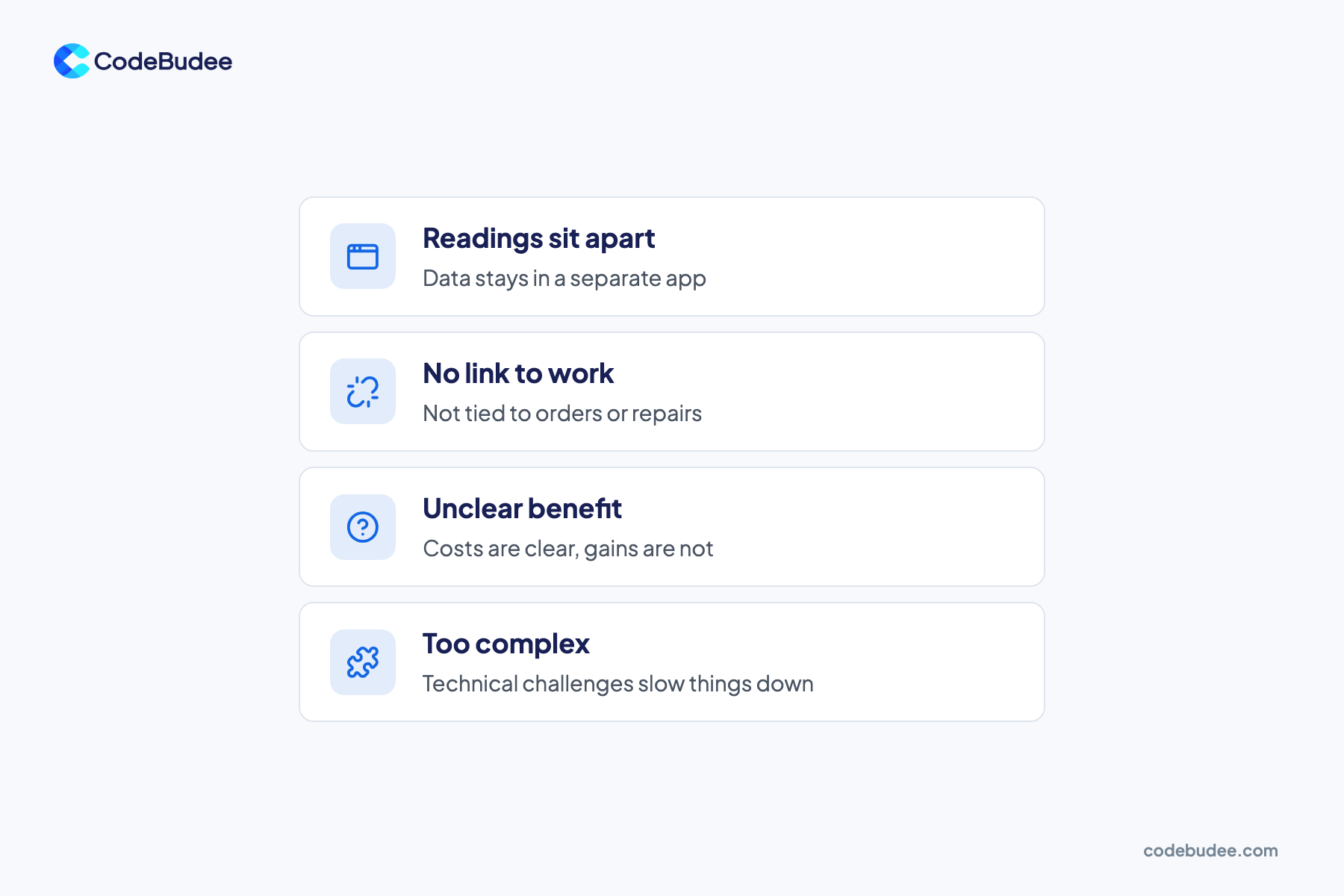
IoT projects stall after the pilot when the trial proves the sensor works but shows no business gain. The readings sit in a separate app. Nobody links them to orders, repairs or reports. Without that link, the costs are clear but the benefit is not, so the project never grows.
Many projects begin with a pilot, or proof of concept: a small trial to show an idea works. Many never get past that step. A Cisco survey in 2017 found 60% of IoT initiatives stall at proof of concept. Only 26% of companies called one a complete success. Data quality and joining work across teams were among the top five challenges.
Microsoft heard the same story. In its IoT Signals report in 2019, 30% of projects failed at proof of concept. The report says this was often because costs were high or the benefits were unclear. Also, 38% of IoT users named complexity and technical challenges as a barrier.
How does sensor data reach the systems that run your business?
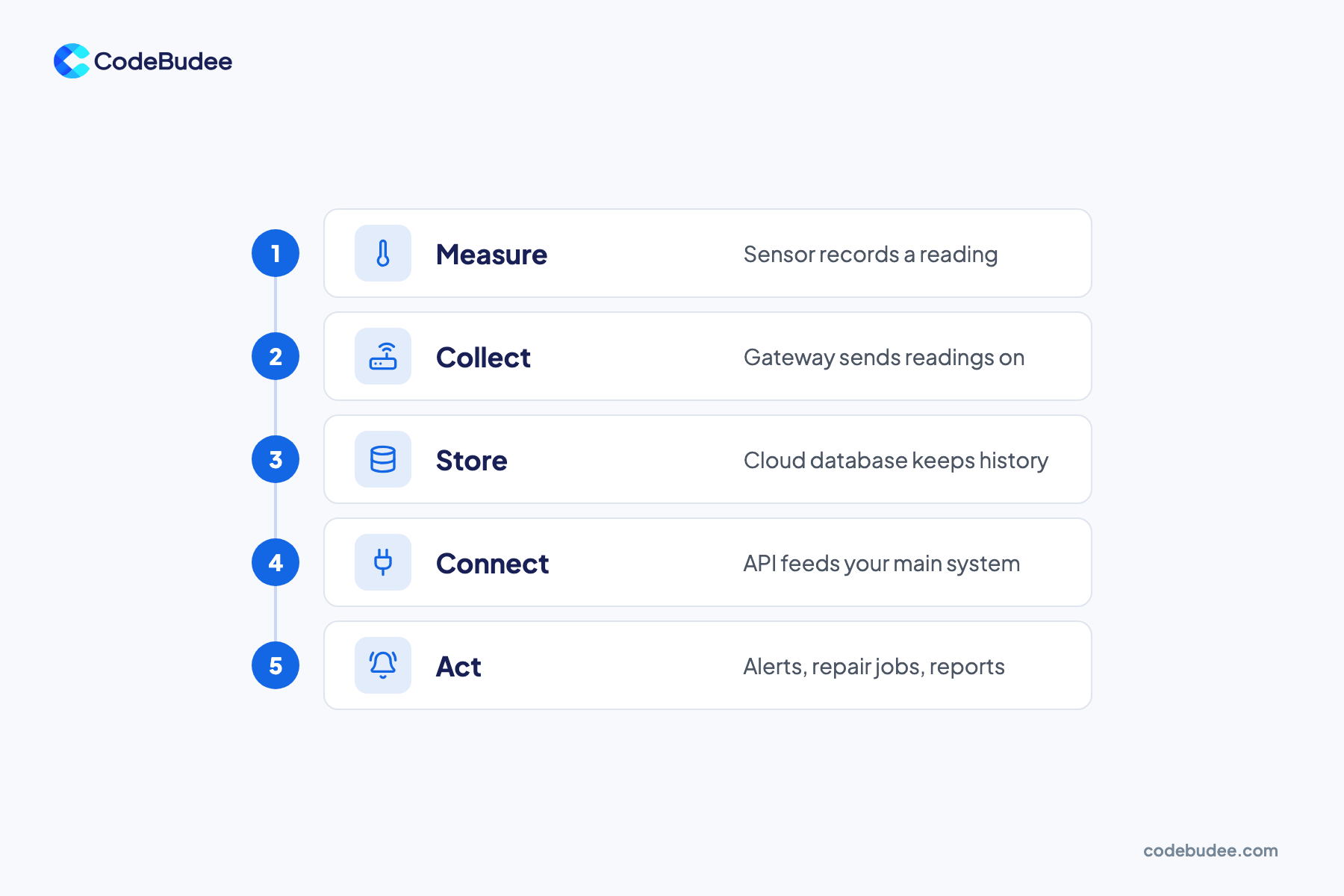
Sensor data reaches your business systems in five steps. The device measures and sends readings. A gateway collects them and passes them on. A data store keeps the history. An API passes the right readings to your main system. Then that system acts, with an alert, a work order or a report.
Here is the path in plain words:
- Measure: The sensor records a reading, such as a freezer temperature, every few minutes.
- Collect: A gateway, a small box on site, gathers readings from many sensors and sends them over the internet.
- Store: A database in the cloud keeps every reading, so you can see trends later. Here is how cloud systems help a business grow.
- Connect: An API passes the readings into your ERP, maintenance or stock system. An API is a way for two systems to talk to each other. ERP is the main system that runs orders, stock and accounts.
- Act: Rules turn readings into actions. A warm freezer raises an alert. A worn machine opens a repair job.
Step 4 is where many projects get stuck. The supplier's app shows a chart, but your other systems never see the data. So staff copy numbers by hand, and the sensor saves no time. If that sounds familiar, read why teams move from Excel to web apps.
Should you buy an IoT platform or build a custom system?
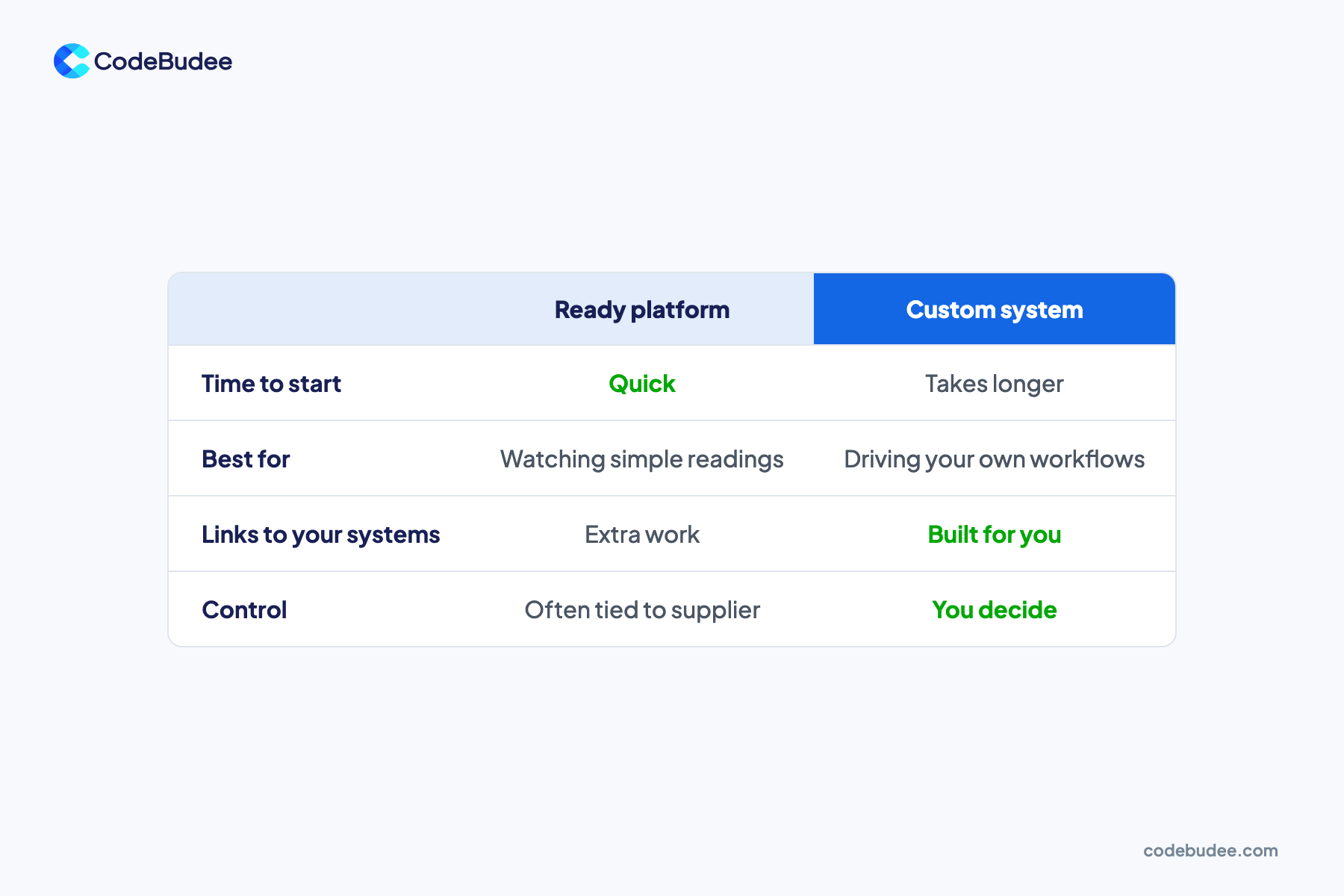
Buy a ready IoT platform when your need is standard, like watching a few readings on one screen. Build a custom system when sensor data must drive your own workflows, such as orders, repairs or billing. Some firms mix the two. They buy the devices and connection, then build the part that links to their business.
Option A: buy a ready IoT platform
- Quick to start, with charts and alerts out of the box.
- Fine when you only need to see readings and get simple alerts.
- Linking it to your own systems still takes extra work, and you pay an ongoing subscription.
Option B: build a custom system around your workflow
- Takes longer to start, because the links to your systems are built for you.
- Readings flow into the tools your team already uses, so nobody re-types them.
- You decide what happens next, and you can change it as the business grows.
Ready platforms often lock you into one supplier. The same Cisco survey found joining work across teams was a top challenge. A separate platform adds one more thing to join.
Bottom line: buy a platform to watch simple readings. Build a custom system when the data must change how work gets done. That is where custom web app development fits.
How do you start an IoT project that reaches production?

Start an IoT project with one costly problem. Pick a problem you can measure, like spoiled stock or surprise breakdowns. Prove the full path from sensor to action on a small scale. Secure every device from day one. Then grow only after the numbers show a real gain.
- Pick one problem: Choose one cost you can count, like how much stock spoils each month.
- Set the goal: Agree on the number that must change, and by how much, before you buy anything.
- Map the data path: List which systems must receive the readings and who acts on them.
- Build the full path small: Connect a few devices all the way to an action in your system.
- Secure the devices: Change default passwords, encrypt the traffic and keep devices on their own network. Encrypted means scrambled so outsiders cannot read it.
- Measure, then scale: Compare the result with your goal, then add more sites or machines.
Security deserves a step of its own. The 2020 Unit 42 IoT Threat Report by Palo Alto Networks found 98% of IoT device traffic was unencrypted. It also found 57% of IoT devices were open to medium or high-severity attacks.
Frequently asked questions
What is a simple example of IoT in business?
A cold room with temperature sensors is a simple example. The sensors send readings every few minutes. When the room gets too warm, the system alerts the manager and logs the event. Staff no longer walk round with a clipboard, and spoiled stock is caught early instead of found too late.
Do we need to replace our current systems to use IoT?
No, in most cases you do not. Sensor data can flow into the systems you already run through an API. The work is in building that link and the rules that act on the data. Replace a system only if it cannot accept data from outside at all.
How long does an IoT project take?
It depends on how many devices, sites and systems are involved. A small trial on one problem is much faster than a company-wide roll-out. Start small, prove the full data path, then plan the wider roll-out from real results. That trial also gives you a fair base for any quote.
How much does an IoT system cost?
Cost depends on the number of devices, how many systems you link and how much custom work is needed. Ask for an itemised quote with no hidden costs, split into devices, connection and software. For a wider view, read our cost-benefit guide to custom software.
Your next step
Sensors are the easy part of IoT. The value comes when their readings reach the systems your team already uses and trigger action. Pick one costly problem, map where its data must go, and prove that path small. Secure every device from the start, then scale what works.
Book a free consultation to talk through your first IoT project and the systems it needs to reach.
