
A customer asks for an e-invoice, and you are not sure you need to issue one. A friend says it is the law. Another says small firms no longer have to. Both can be right, because the rule changed this year.
This guide gives the plain answer. Here you will see who must issue e-invoices and when each group had to start. You will also see what happens if you do not, and how to set up your systems.
Key takeaways
- E-invoicing is mandatory in Malaysia if your annual turnover or revenue is RM3 million or more.
- Below RM3 million you are exempt. The line moved up from RM1 million on 1 September 2026.
- Not complying is an offence. The fine is RM200 to RM20,000, or up to 6 months in jail, or both.
- If you use a provider to send your e-invoices, check what it sends for you.
- Your systems must be ready to issue, send and keep each e-invoice.
Is e-invoicing mandatory in Malaysia?
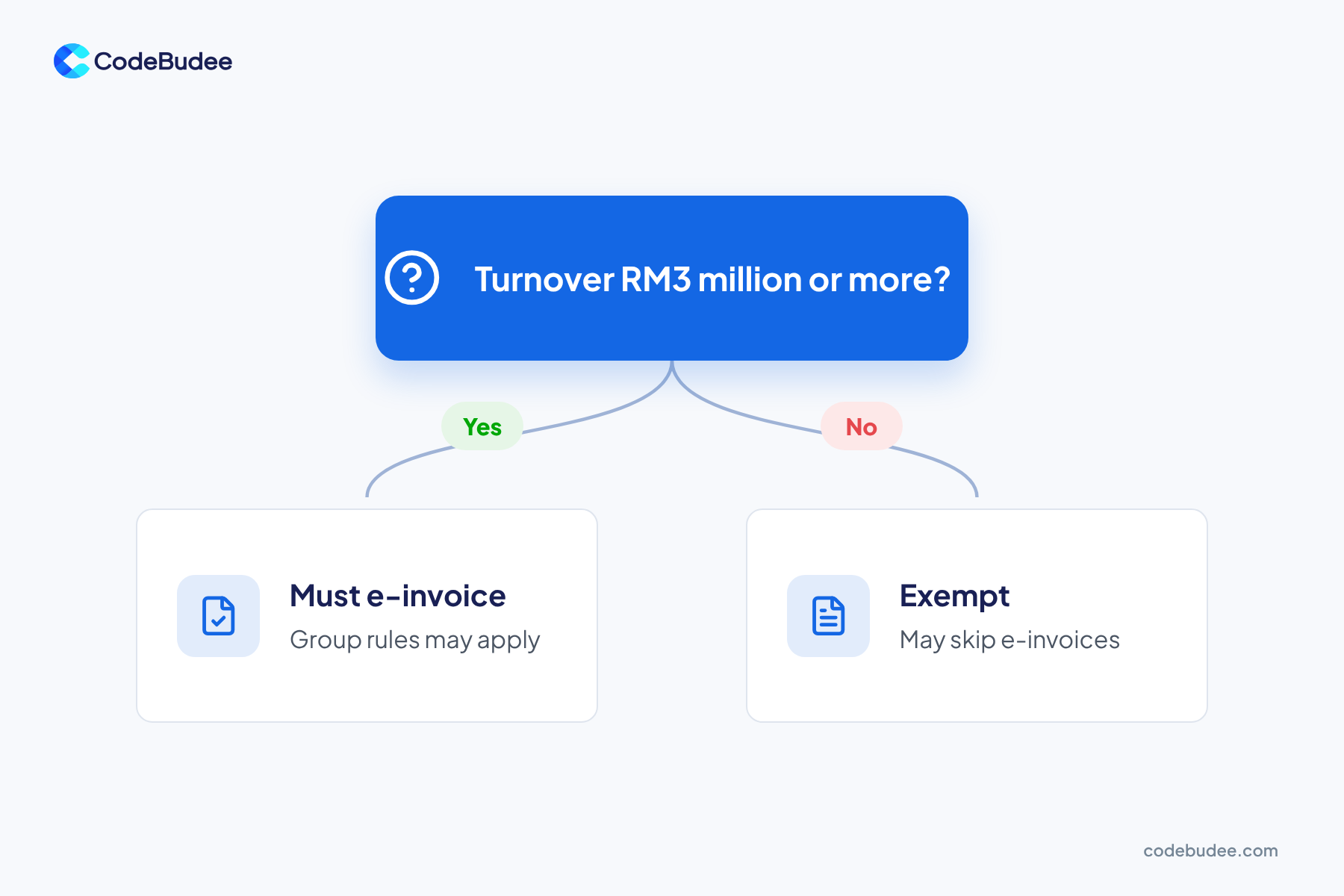
Yes, for most medium and large businesses. E-invoicing is mandatory if your annual turnover or revenue is RM3 million or more. Taxpayers below that line are exempt, according to LHDN's timeline page. LHDN is the Inland Revenue Board, Malaysia's tax authority.
This exemption line is new. The government raised the threshold from RM1 million to RM3 million, effective 1 September 2026. LHDN says more than 1.1 million businesses now fall outside the rule.
There is one catch. Some group structures lose the exemption. These are taxpayers with a non-individual shareholder, a holding company, or a related company or joint venture. If your company sits in a group, read that part of the guideline before you assume you are exempt.
When did it start for each business size?
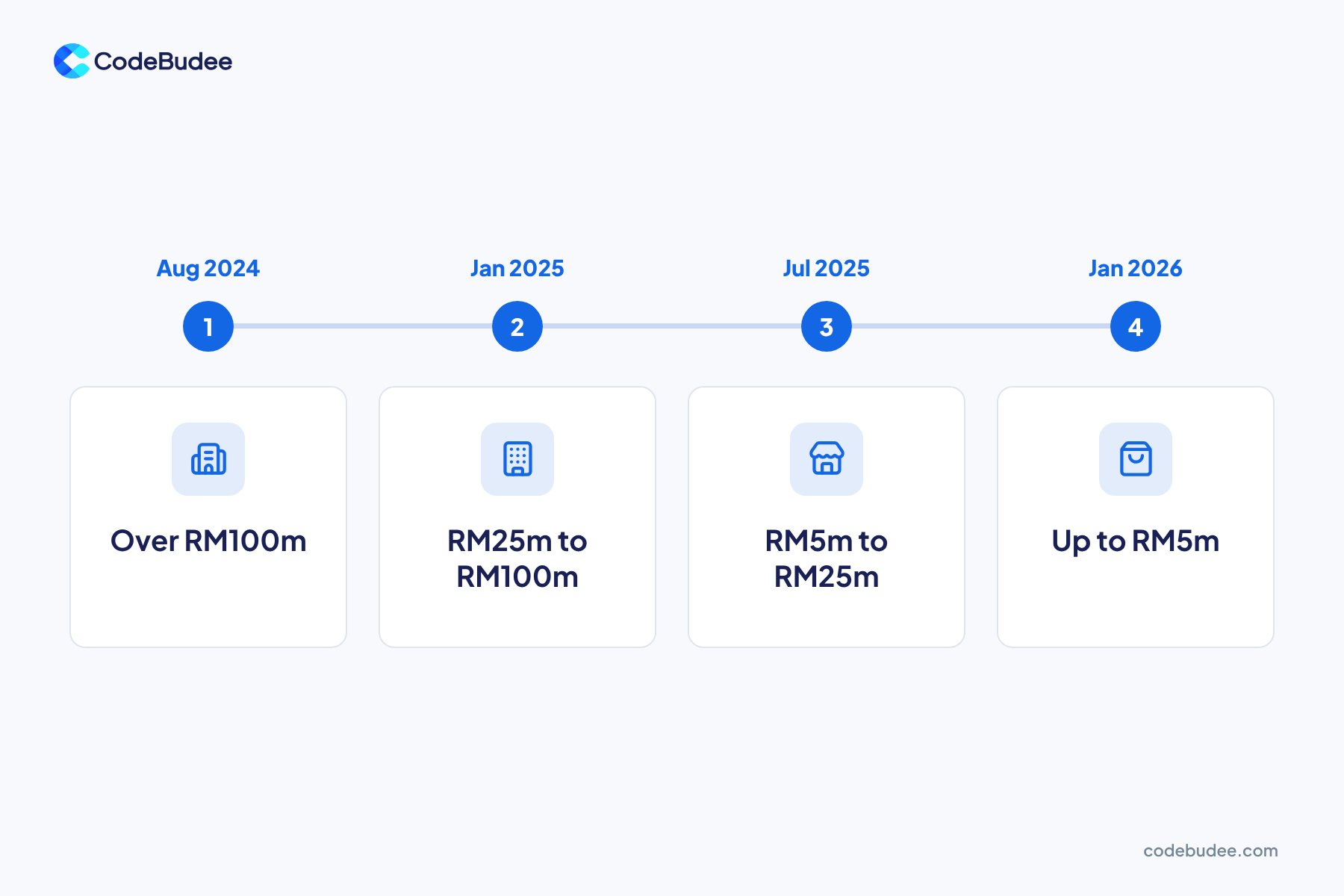
E-invoicing was rolled out in four phases, from the biggest businesses down. LHDN's timeline sets each start date by annual turnover or revenue. The last phase began on 1 January 2026.
- 1 August 2024: turnover of more than RM100 million.
- 1 January 2025: more than RM25 million and up to RM100 million.
- 1 July 2025: more than RM5 million and up to RM25 million.
- 1 January 2026: turnover of up to RM5 million.
The newer RM3 million exemption now sits on top of that table. So a business with RM2 million in turnover was once in the last phase. Today it is exempt.
Many firms have already joined. In October 2026, LHDN's chief executive said that 268,000 taxpayers have joined the e-invoice programme. Your customers and suppliers are likely among them.
What if your turnover is under RM3 million?

Issuing e-invoices is not required. KPMG notes that suppliers below the threshold may issue invoices in a non-electronic format. You may still choose to join.
Your larger customers may still ask for help. The Star reported in September 2026 that larger firms were asking some exempt suppliers for tax and registration details. Tax expert Datin Christine Koh said a larger firm can use the supplier's normal invoice or receipt as proof.
So the practical answer for a small firm is simple. Keep your normal invoices valid and tidy. Give your customers the details they ask for. Then decide if joining makes sense for you. When a customer asks for e-invoices, ask what they need from you.
What happens if you do not comply?
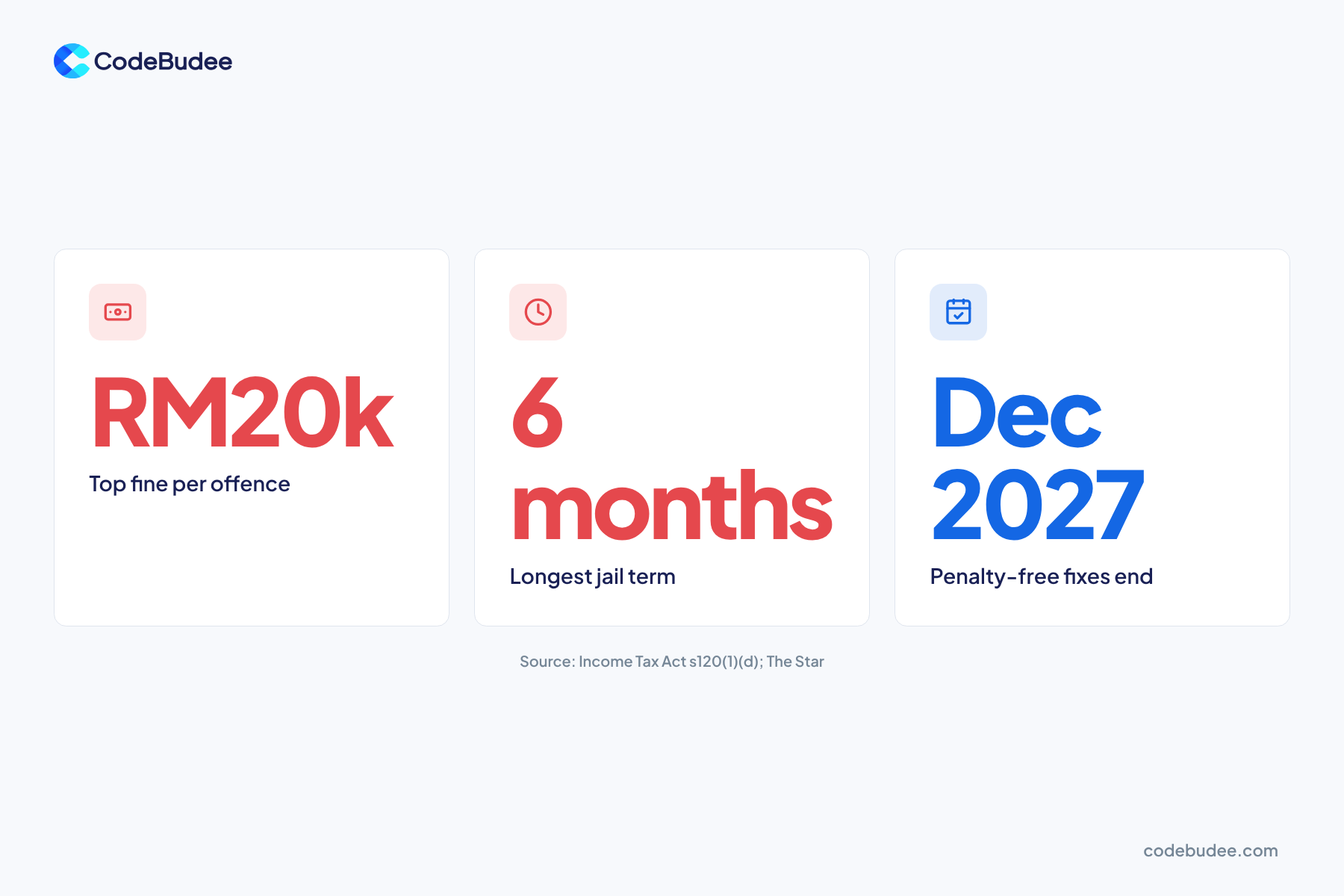
Failing to issue an e-invoice is an offence under Section 120(1)(d) of the Income Tax Act 1967. Each case can mean a fine of RM200 to RM20,000, or up to 6 months in jail, or both.
Check what your tool sends for you, and keep your own copies of each invoice.
There is a safety net for past mistakes. Taxpayers can correct e-invoice reporting errors without financial penalties until 31 December 2027, as reported in October 2026.
How should your systems issue e-invoices?

You have three ways to issue e-invoices. Pick the simplest one that fits how many invoices you send and how your business works.
- MyInvois Portal: LHDN's own website. You key in or upload each invoice yourself. This suits a business with few invoices.
- Accounting software or a provider: a tool that sends e-invoices for you. Some providers submit documents on behalf of their customers. It works the way the tool is built.
- Your own system: your billing or operations system connects to LHDN through an API (a link between systems). This suits firms with odd workflows or many connected systems.
Whichever way you pick, ask three questions first. Who sends the invoice? Where does the invoice data come from? Who checks it before it goes out?
Bottom line: if invoicing is a small job, use the portal or a ready-made tool. If invoices come out of several systems, or you re-key the same data twice, connect your own system.
The system is the easy part. The process behind it is harder. When your invoice data lives in loose spreadsheets, an e-invoice will only send the mess faster. Fix the process first, as in business process optimisation: 5 steps before you automate. Moving from sheets to one system is covered in replacing Excel with a web app.
How CodeBudee approaches e-invoicing
We built a custom loan management platform with LHDN MyInvois e-invoicing for a Malaysian moneylender. Statutory reports went from about a week to instant. About 10 hours a week of manual re-entry went away.
That is the idea behind custom web app development. Your invoicing is built into the system you already run on, shaped around how you work. You get a clear, itemised quote with no hidden costs, and you own the code. What sets the price is covered in how much custom software costs.
Frequently asked questions
Is e-invoicing mandatory for small businesses?
No, not if your turnover is below RM3 million. Since 1 September 2026, those businesses are exempt. You may still choose to join. Check the group rules first if your company has a holding company or related companies.
Does the RM3 million rule apply to my whole group?
Not always. Some groups lose the exemption. Examples are a taxpayer with a non-individual shareholder, a holding company, or a related company or joint venture. Read that section of the guideline, or ask your tax adviser, before you stop issuing e-invoices.
What should I check if a provider sends my e-invoices?
Ask what it sends on your behalf. Keep your own copy of every invoice, so you can compare it with what was sent.
Can I fix past e-invoice mistakes without a penalty?
It may be possible. Taxpayers can correct e-invoice reporting errors without financial penalties until 31 December 2027, as reported in October 2026. Ask your tax adviser how this applies to your case.
Your next step
Check your turnover and group structure first. Then check how your invoices are made today, and who answers for them. Does your invoicing run on spreadsheets or tools that do not connect? Book a free consultation to talk through your e-invoicing and your systems.
