

Your board asks for an AI plan. You search for the leading AI development companies in Malaysia and get long lists of names. Each list tells you who exists. None of them tells you who fits your business.
That worry about falling behind is fair. But a rushed pick can cost more than a careful one. This guide explains what an AI development company does and why many AI projects stall. It gives you six questions to ask and the red flags to watch for. It ends with a simple rule for buying versus building.
Key takeaways
- An AI development company builds working software with AI inside it. Slides and tool licences are not the product.
- Many AI projects stall after the trial stage. In IBM's 2025 CEO study, only 25% of AI initiatives delivered the expected return.
- Judge a vendor on live systems, ownership, data handling, testing and support, not on a polished demo.
- Buy an AI tool for common tasks. Build custom AI when it runs on your own data and core work.
What does an AI development company do?
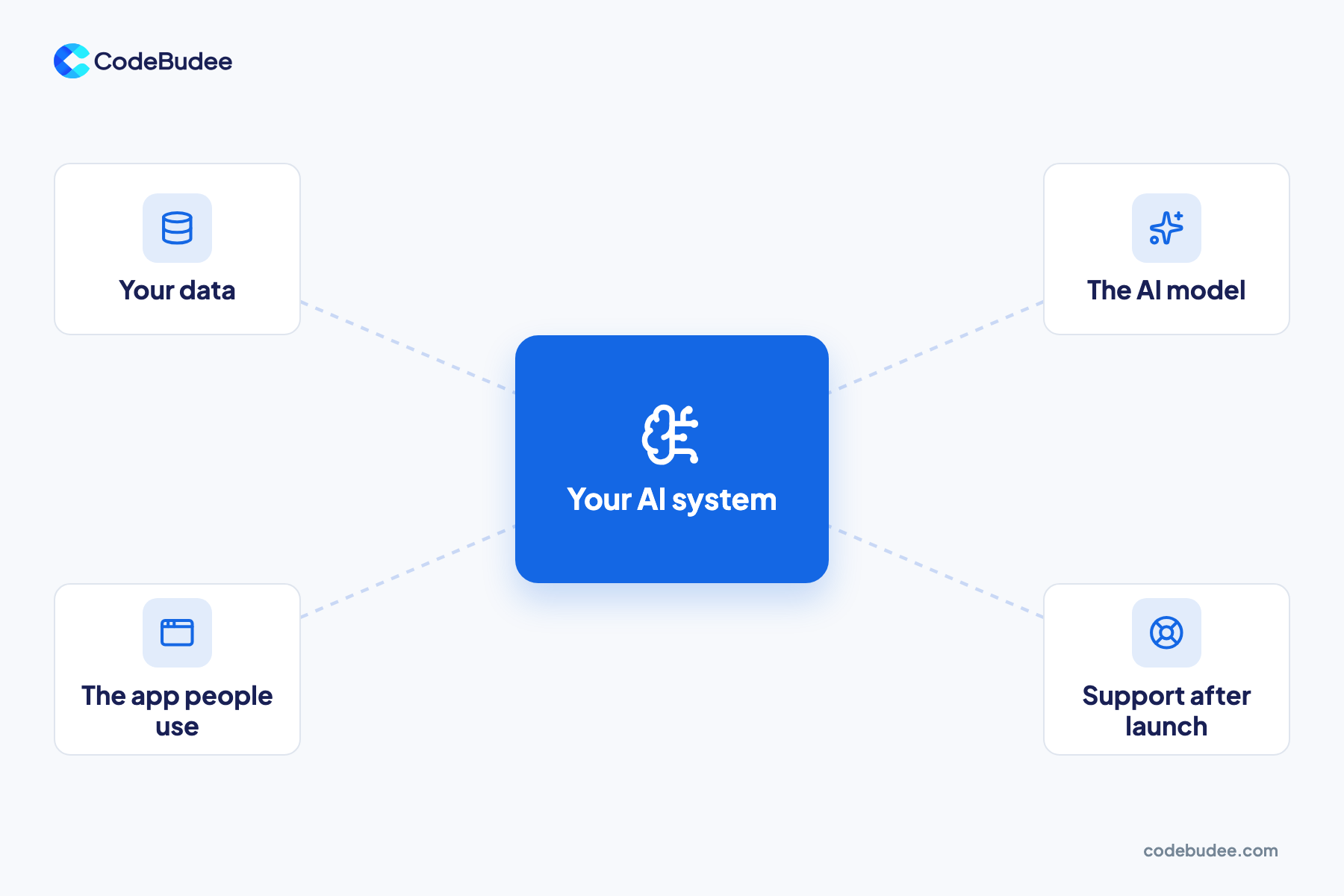
An AI development company builds software that is built around AI. That can be a chatbot that answers from your own records or a tool that reads invoices. The company also builds the parts around the AI. That means the app people use, the links to your data and the security. It also covers support after launch.
It helps to know who else you may meet:
- AI consultants help you plan and choose where AI fits. Many stop at the plan.
- AI tool resellers sell licences for ready-made products. You adapt your work to the tool.
- AI development companies design, build and run a system around how you work.
Interest is high everywhere. In the Stanford AI Index 2025, 78% of organisations used AI in 2024. A year earlier it was 55%. That is why lists of vendors keep growing.
Why do so many AI projects stall after the pilot?

Many AI projects stall because a demo is easy and a dependable system is hard. A pilot (a small trial) runs on clean sample data with a few friendly users. Real use brings messy data, more users, links to other systems and running costs. Many teams never plan for that step.
This happens a lot. IBM's CEO study, which surveyed 2,000 CEOs in 2025, found only 25% of AI initiatives delivered the expected return. Only 16% had scaled across the whole company.
BCG's 2024 study of 1,000 executives tells a similar story. It found 74% of companies have yet to show tangible value from AI. Only 26% had the skills to move beyond proofs of concept.
BCG also found where the leaders spend. They put 10% of their resources into algorithms and 20% into technology and data. The other 70% goes into people and processes. So pick a partner who asks about your people and your process, not only your model.
What questions should you ask an AI development company?
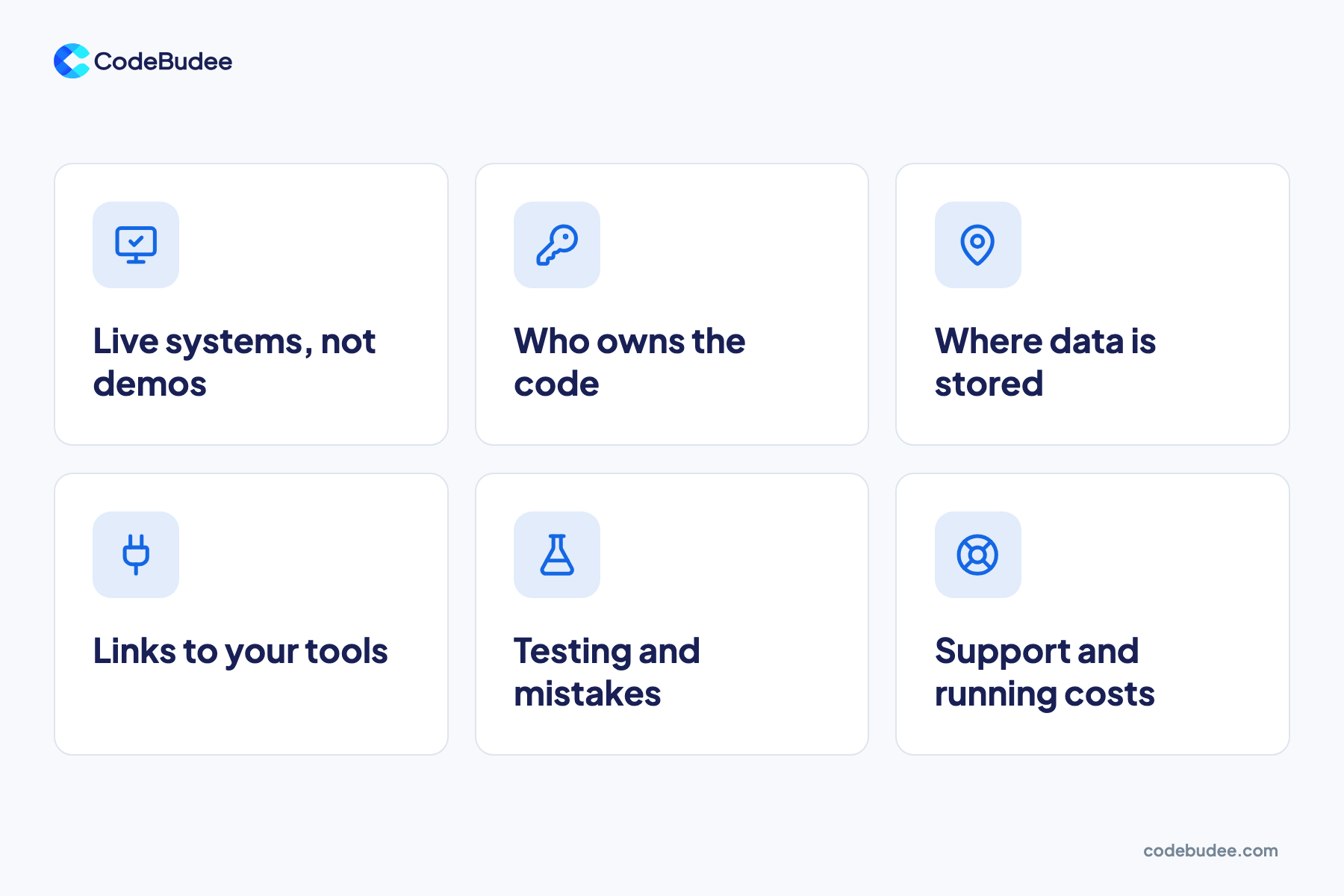
Ask questions that show how a vendor handles real use, beyond the demo. The six below cover proof, ownership, data, links to your tools, testing and support. A good vendor answers each one plainly, in writing, before you sign. Vague answers now often mean surprises later.
- Can you show a system you built that people use today? A live system proves more than a slick demo.
- Who owns the code, the data and any tuned model? Get this in the contract, not in a chat.
- Where will our data be stored and processed? Some AI services process data on servers outside Malaysia. You need to know where.
- How will the system get data from our other tools? Ask what an API (a way for two systems to talk to each other) is needed for.
- How will you test it, and what happens when it is wrong? Ask for an accuracy target and a human check on risky answers.
- Who supports it after launch, and what will it cost to run? Many AI services charge by usage, so running costs grow as more people use it.
If your data is scattered, start there. Our guide to signs your business data is not ready for AI shows what to fix first.
What are the red flags when hiring an AI development company?
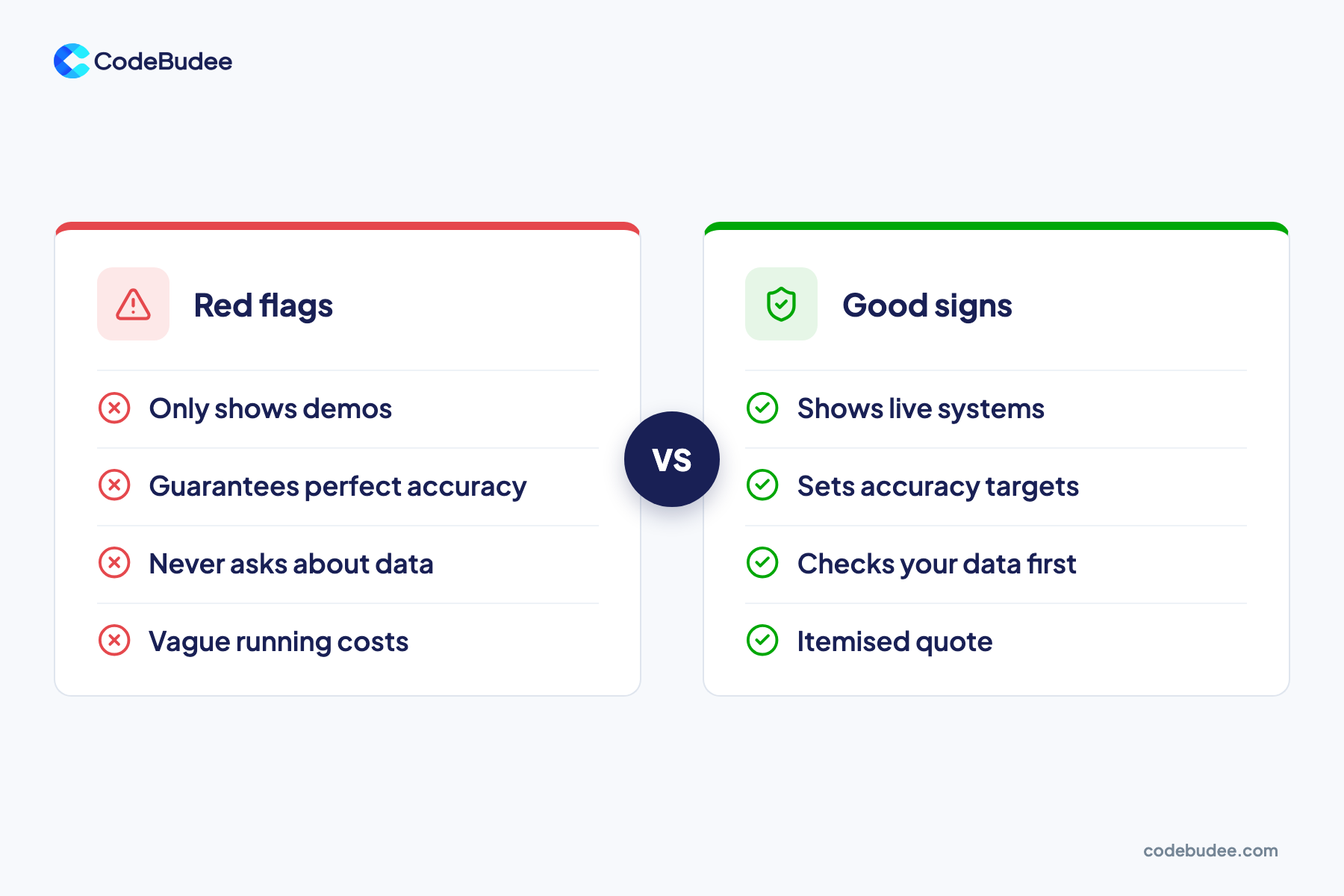
Watch for a vendor who talks only about the AI. A good one also asks about your data and your process. Others include guaranteed accuracy, demos with no live systems behind them and vague running costs. Good vendors do the opposite: they check your data first and put numbers in writing.
Red flags:
- They promise perfect accuracy. AI makes mistakes, so a fair vendor talks about targets and checks.
- They never ask to see your data before quoting.
- They cannot say what the system will cost each month to run.
- The contract leaves the code or the model with them.
Good signs:
- They show a live system and explain what went wrong along the way.
- They set a clear accuracy target and a plan for errors.
- They give an itemised quote with no hidden costs.
- They suggest a simpler tool when custom AI is not needed.
Should you buy an AI tool or build custom AI?

Buy an AI tool when the task is common and the same for every business. Drafting emails and summarising meetings are good examples. Build custom AI when the work runs on your own data, follows your own process or sets you apart. Custom costs more upfront, but it fits fully and you own it.
Buy an AI tool when:
- Many businesses do the task the same way.
- The tool does not need deep access to your own systems.
- You can live with the way the tool works.
Build custom AI when:
- The answers must come from your own records and rules.
- It must connect to the systems you already run.
- It is core to how you serve customers or make money.
Bottom line: start with a ready-made tool where it fits. Build custom where your data and process are the point.
Unsure whether to train your own model? Our guide on training your own AI model or using RAG compares the two in plain words.
What do Malaysia's AI guidelines mean for your choice?

Malaysia has a voluntary AI Code of Ethics for organisations that build and use AI. It is guidance, not law, but it gives you a fair checklist for any vendor. Ask how their system follows it. Personal data rules still apply too, so ask how they protect the data the AI uses.
Malaysia's AI Code of Ethics (AICE) comes from AI Malaysia Berhad, the National AI Office. It is "a voluntary, non-binding guideline" for "organisations, AI developers, deployers, researchers, and other stakeholders". It builds on the seven principles in Malaysia's National Guidelines on AI Governance and Ethics.
Data protection matters as much. An AI system often touches customer records, so a leak can follow. Our guide on what a data breach is explains what is at stake.
How CodeBudee approaches this
CodeBudee builds AI-powered solutions: new systems and apps with AI at the core. We do not add AI into someone else's existing software. We build the system around how your business works. At the end, you own 100% of the source code.
You talk directly to the person leading the build. You get a clear, itemised quote with no hidden costs. See how we approach custom web app development for AI-powered systems.
Frequently asked questions
How much does it cost to hire an AI development company in Malaysia?
It depends on the scope, the state of your data and how many systems the AI must connect to. Also count the running costs, because many AI services charge by usage. Ask for an itemised quote that splits the build from the monthly costs. Our guide on what sets the price of custom software explains the main cost drivers.
What is the difference between an AI consultant and an AI development company?
An AI consultant helps you decide where AI fits and builds a plan. An AI development company builds the working system and supports it after launch. Some firms do both. When you already know the problem, a development company can often shape the plan during the build.
Do we need clean data before we hire an AI development company?
No, but you need to know where your data stands. A good vendor will check your data early and tell you what must be fixed first. Messy data can stall an AI project. Fixing it is often the first piece of real work.
Should we start with a pilot?
Yes, if the pilot is planned as the first step to real use. Agree in advance what result counts as success. Also agree what the full system will need: real data, more users and links to your other tools. A pilot with no path to production rarely gets past the trial stage.
Your next step
A list of names will not tell you which AI development company fits your business. The right questions will. Ask for live systems, clear ownership, a plan for your data, honest testing and support after launch. Then start small, with a pilot that has a real path to production.
Book a free consultation to talk through where AI could help your business.
