
You type "build me a booking app for my salon" into ChatGPT. Within a minute, you have pages of code. You may even get a preview you can click. It feels like the app is done.
In business, that code is usually only the start. ChatGPT can write code and help you shape an idea fast. On its own, it cannot give you an app that customers and staff rely on every day. This guide shows what ChatGPT does well and what it leaves to you. It also covers the security numbers and the app store rules. Last, it gives you a simple test for when you need a software team.
Key takeaways
- ChatGPT can write app code, and on paid plans it can host simple web apps. It does not publish to the app stores or look after a business app for you.
- In Veracode's 2025 tests, AI-generated code added risky security flaws in 45% of tests. Someone must review it.
- Getting onto the App Store or Google Play takes developer accounts, testing and a store review in your name.
- If your business will depend on the app, bring in a software team to build and run it.
Can ChatGPT build an app?
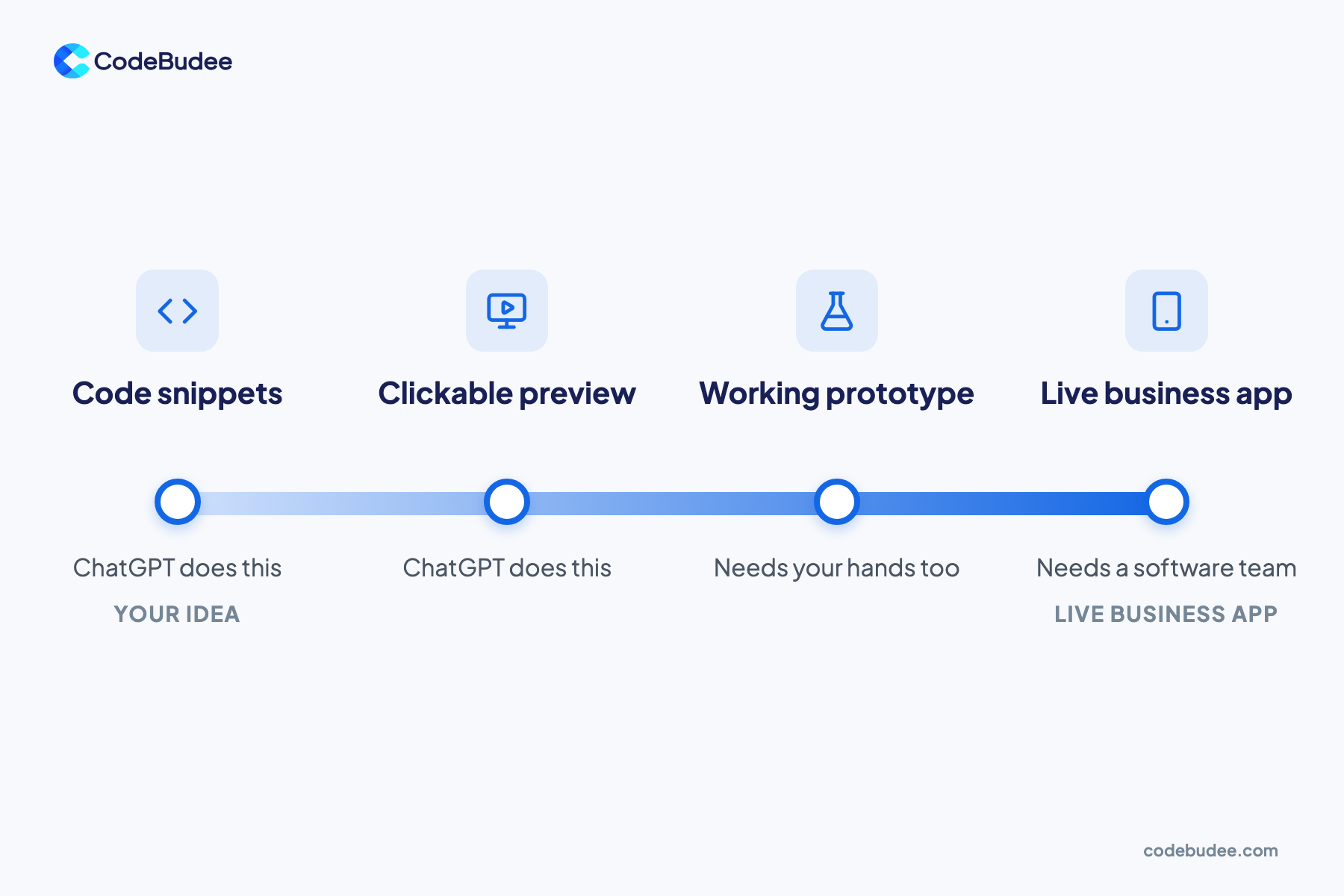
Yes, in part. ChatGPT can write the code for screens, forms and small tools. On paid plans, it can also host simple web apps. But it will not publish to the app stores or own your security checks. Nor will it fix bugs next month. You or a software team must do those parts.
Its hosting comes from ChatGPT Sites, which is still in public beta. At launch, it does not let you choose which country holds your data. That matters if your rules say where customer data must stay.
Think of ChatGPT as a fast helper that never sees your live system. It writes what you ask for. It does not know your customers, your other tools or your rules unless you explain them.
Software developers lean on these tools too. In the Stack Overflow Developer Survey 2025, 84% of respondents use or plan to use AI tools. Yet 72% said they do not "vibe code", meaning build software from AI prompts alone.
What can ChatGPT do well when you plan an app?

The best use of ChatGPT comes before and around the build. It can turn a rough idea into a feature list and sketch the screens. It can write small pieces of code and explain code in plain words. Used this way, it saves you time and helps you brief a developer clearly.
Good jobs to give it:
- Shape the idea: list who will use the app, their main tasks and the screens each one needs.
- Make a prototype: a rough early version you can click through, to show staff or investors.
- Write small tools: a one-off script or a simple page only your team uses.
- Explain terms: for example, an API (a way for two systems to talk to each other).
- Draft your brief: the questions to ask a developer and what "done" should look like.
Scope drives price, so a clear brief matters. Our guide on what sets the price of custom software explains why.
What does a real app need that a chat cannot give you?

A real app is more than code. It needs a server that stays up, a database with backups and safe logins. It needs links to your payment and accounting tools, plus someone to fix and update it. ChatGPT can write parts of each and host a simple web app. It cannot take responsibility for any of them.
Here is what sits below the code:
- Hosting and backups: a place where the app runs day and night, with copies of your data.
- Logins and roles: staff see what their job needs, and customers see only their own records.
- Links to your systems: payments, accounting, stock or bookings, all kept in step.
- Fixes and updates: phones get new system versions, and your app must keep working on them.
This is the step where many first versions get stuck. Our guide on moving from MVP to production covers it in detail. An MVP (minimum viable product) is the first, simplest version of an app.
Is code written by ChatGPT safe to run your business on?

Not without a careful review. AI tools can write code that works in a demo but hides security holes. In Veracode's 2025 GenAI Code Security Report, AI-generated code added risky security flaws in 45% of tests. A person who knows security must check it before customer data goes in.
Developers see the same problem. In the Stack Overflow Developer Survey 2025, 46% said they distrust the accuracy of AI tools. Only 33% said they trust it. Their biggest frustration, named by 66%, was AI answers that are "almost right, but not quite".
In plain terms, code that looks finished may still expose data. A leak costs money and trust, as our guide on what a data breach is explains. Treat ChatGPT's code as a first draft, never the final version.
How do you get an app onto the App Store or Google Play?

Apps go out under your own developer accounts, and the stores review them first. Apple charges 99 USD per membership year. Google Play charges a US$25 one-time fee. ChatGPT can explain the steps, but the accounts, testing and submission stay in your name.
Here is the usual path:
- Open developer accounts: one with Apple and one with Google, in your company's name.
- Build and sign the app: package the code for the stores. A digital signature proves the app is yours.
- Test with real users: new personal Google Play accounts made after 13 November 2023 need 12 testers or more. Each must stay signed up as a tester for at least 14 days in a row.
- Pass store review: both stores check the app before it goes public.
- Keep it live: renew your membership and update the app when store rules change.
Web apps skip the stores, because people open them in a browser. They still need hosting, logins and upkeep.
When is ChatGPT enough, and when do you need a software team?

Ask one question: will your business depend on this app? If it is a personal tool or a rough prototype, ChatGPT is often enough. If customers, payments or private data run through it, you need a software team. That team builds it, secures it and looks after it.
ChatGPT is enough when:
- Only you or a few staff use it.
- No customer or payment data goes in.
- It is fine if it stops working for a day.
Bring in a software team when:
- Customers or staff use it every day.
- It holds personal data or takes payments.
- It must connect to your other systems.
- You need it in the App Store or Google Play under your brand.
Bottom line: use ChatGPT to test the idea. Then hand it to a team before your business relies on it.
Weighing other AI tools as well? See our guide on AI app builders vs custom app development for a side-by-side view.
How CodeBudee approaches this
Bring your ChatGPT prototype or page of notes to a first talk with us. It is a useful start. We build custom software around how your business works day to day. You talk directly to the person leading the build. At the end, you own 100% of the source code.
Take the property management system we built for an Australian agency. Its mobile app works on site with no wifi, and the website and system stay in sync. The client owns the system outright. That is the kind of app a chat cannot hand you. You can see more of our work, or learn about our custom mobile app development.
Frequently asked questions
Can ChatGPT build a mobile app for iPhone and Android?
It can write much of the code for one. It cannot open your developer accounts or get the app through store review for you. Both Apple and Google charge developer fees and check each app before it goes live. Any data the app stores also needs hosting. For most businesses, ChatGPT gets you to a prototype, not a store-ready app.
Can I build an app with no money?
ChatGPT's free plan is enough for a rough prototype. Publishing costs money, though. Apple and Google both charge developer fees, and a live app usually has hosting costs. A free prototype is a good way to test an idea before you pay for a real build. It also helps you explain the idea to a developer.
Which AI is best for building an app?
The tool matters less than what happens after the code. ChatGPT and similar AI tools all write code that needs review, hosting and upkeep. Pick the one you find clearest for planning and drafting. Then judge the result by the same checks. Look for a security review, backups, safe logins and someone to look after it.
Can a software team use my ChatGPT prototype?
Yes, as a starting point. A prototype shows what you want far better than a long email. A team will check the code and keep what is sound. They may rebuild core parts, like logins and data storage, so they are safe. Bring the prototype and your chat notes to your first meeting.
Your next step
ChatGPT can build parts of an app, and it is a great way to test an idea. It does not give you a security review, store approval or someone to fix things later. Use it to shape your idea and your brief. When your business will depend on the app, bring in a software team. Pick one that builds it properly and stays after launch.
Book a free consultation to talk through your app idea, ChatGPT prototype included.
