
Picture a beauty chain that has grown to 20 branches, while every booking is still keyed in by hand. The owner knows the business needs to "go digital". But where do you start? Most guides answer with a list of pillars, then stop.
This guide names the four pillars of digital transformation in plain words. It shows why most projects fall short, which pillar holds up the others, and where to start. You will also get a simple rule for when to buy tools and when to build your own.
Key takeaways
- Four pillars come up again and again: customer experience, operations, people, and technology and data.
- BCG found 70% of digital transformations fall short of their goals, so the order you work in matters.
- Technology and data hold up the other three pillars. Disconnected systems slow every one of them.
- Start where your staff type the same data twice. It is the cheapest problem to find and the fastest to prove.
- Buy tools for standard tasks. Build your own system where your way of working sets you apart.
What are the four pillars of digital transformation?

In this guide, the four pillars of digital transformation are customer experience, operations, people, and technology and data. Customer experience is how buyers find and deal with you. Operations is how work gets done inside. People is how staff learn and use new tools. Technology and data is the base that links them all.
There is no single official list. Some consultancies use three pillars, others seven. MIT Sloan senior lecturer George Westerman says leaders should prioritise employee experience, customer experience and operations. Our fourth pillar, technology and data, is the one that makes the other three possible.
Here is what each pillar covers in a growing business:
- Customer experience: online booking, self-service portals, mobile apps and faster replies.
- Operations: approvals, stock, billing and reports that run without manual steps.
- People: training, clear roles and tools that staff want to use.
- Technology and data: connected systems, one trusted set of records and secure access.
Why do most digital transformations fall short?
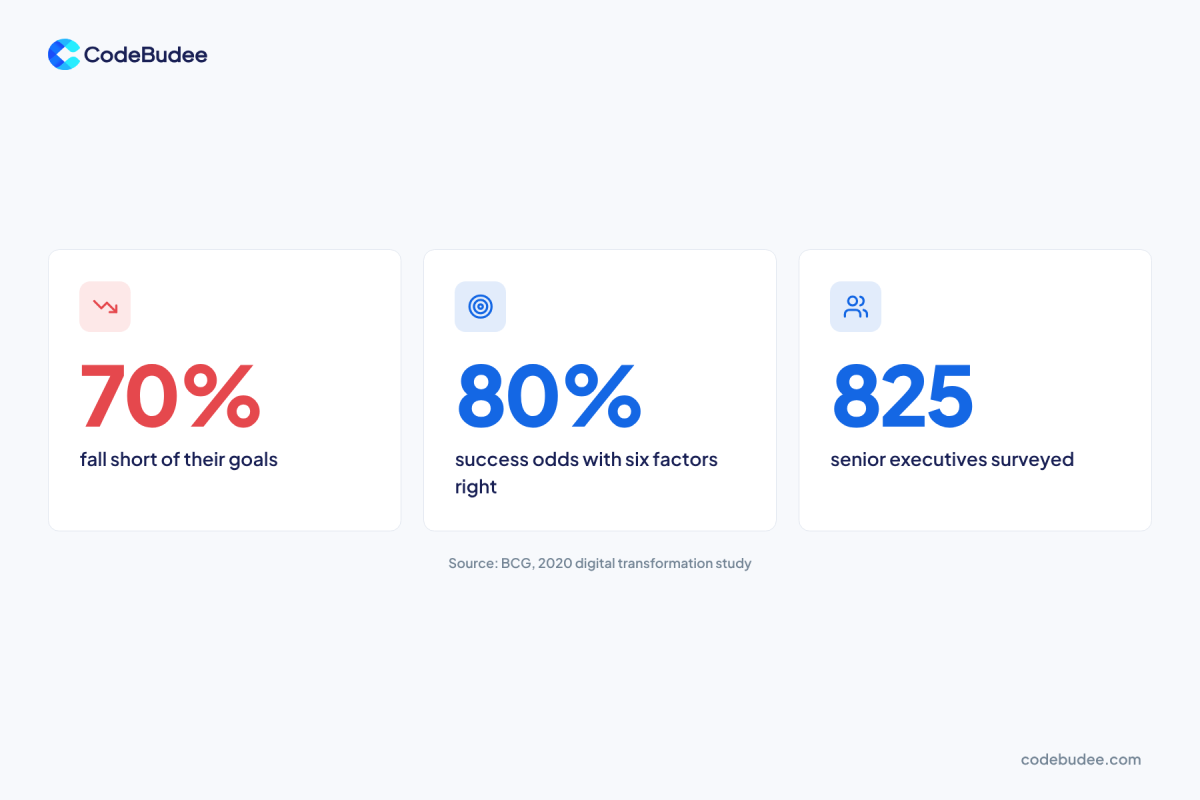
Many digital transformations fall short when strategy, people and data are not in place. BCG studied this in 2020 and found that 70% fall short of their goals. Firms that got six key factors right raised their odds of success from 30% to 80%.
BCG's 2020 research drew on a survey of 825 senior executives. One of its six factors is a business-led, modular technology and data platform. In plain words, the business sets the goals, and the systems are built in parts that can change.
Big sums are at stake. IDC forecasts that worldwide spending on digital transformation will reach almost $4 trillion in 2027. Extra spending will not rescue a weak plan, so the order of work matters.
Why does the technology and data pillar hold up the rest?
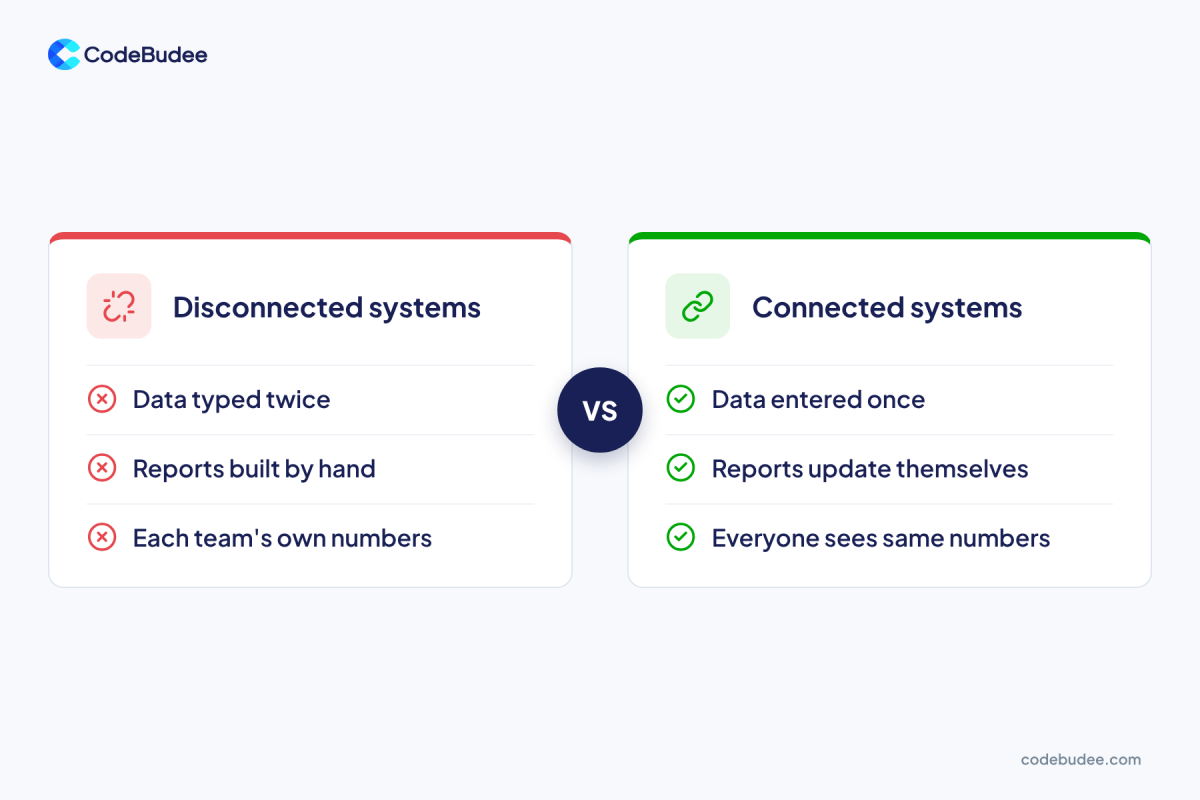
Technology and data hold up the rest because every other pillar runs on shared records. A better customer app fails if staff must copy its orders into another system. Faster operations stall when reports need data from five tools. Staff stop trusting tools that show different numbers.
You can see the size of the gap in the 2025 MuleSoft Connectivity Benchmark. It surveyed 1,050 IT leaders. Organisations use 897 applications on average, but only 29% are typically connected. And 90% of IT leaders say data silos are creating business challenges.
A data silo is information locked inside one tool or team, where others cannot reach it. Silos force people to re-key data and check it by hand. Our guide to master data management explains how to keep one trusted record for each customer or product.
Which pillar should you start with?
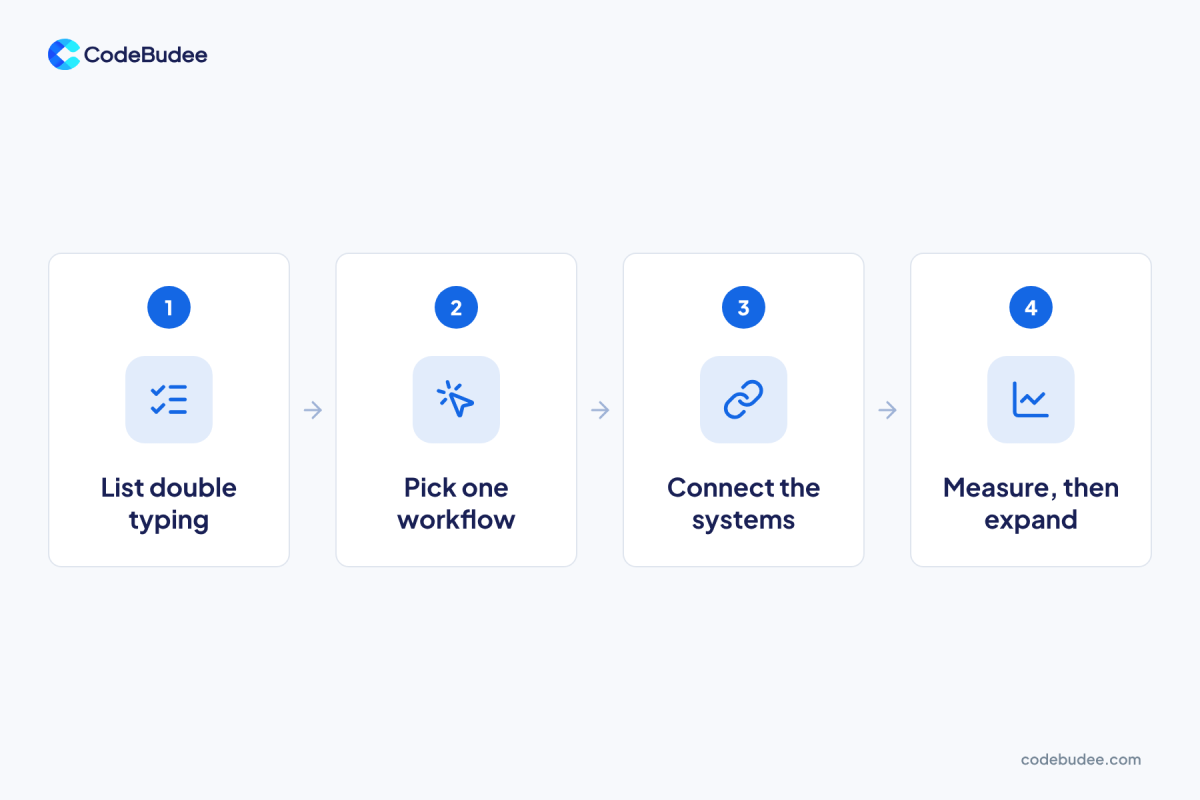
Start with the pillar where your staff type the same data twice. That is usually where operations meet technology and data. Re-keying is easy to spot, simple to measure and cheap to fix. A quick win there also builds trust for the bigger changes later.
Use these four steps:
- List the double typing: ask each team which data they copy from one tool into another.
- Pick one workflow: choose the one that costs the most hours or causes the most errors.
- Connect the systems: link the tools, or replace the step with one system that holds the data once.
- Measure, then expand: track hours saved and errors removed, then move to the next workflow.
Before you automate, map how the work flows today. Our guide to business process optimisation shows how to remove wasted steps first. If the problem lives in spreadsheets, see why teams move from Excel to a web app.
Should you buy tools or build your own for each pillar?

Buy ready-made tools for standard tasks that work the same in every company, such as email or payroll. Build your own system where your way of working sets you apart, or where several tools must share data. Most businesses end up with a mix of both.
Here is a simple split by pillar:
- Customer experience: buy when a standard booking or chat tool fits. Build when your booking rules, pricing or service flow are unusual.
- Operations: buy for common tasks like accounting. Build when your process does not fit any template.
- People: buy training and messaging tools. Build staff apps when field teams need to work offline or on site.
- Technology and data: build the links between systems, so data is entered once and shared.
Bottom line: some tools force your team to work around them or copy data elsewhere. That is the time to consider a custom system.
How CodeBudee approaches this
Often the problem starts where data gets typed twice. For Facial Cat Facebar, a facial chain with 20 branches, every booking was keyed in by hand. We built a multi-branch booking website, so customers now book online themselves.
For MyLoans, a Malaysian moneylender, statutory reports took about a week by hand in Excel. Our custom loan platform made that reporting instant. It also removed about 10 hours a week of manual re-entry. You can see more in our work.
You get a clear, itemised quote with no hidden costs, and you own 100% of the source code. Learn more about our custom web app development.
Frequently asked questions
What are the four pillars of digital transformation?
Four themes come up again and again: customer experience, operations, people, and technology and data. Customer experience covers how buyers deal with you. Operations covers how work gets done. People covers training and adoption. Technology and data is the base that links them. Consultancies use different lists, though these four ideas appear often.
What is the most important pillar of digital transformation?
Technology and data is the pillar the others depend on. A new app, process or training plan still fails if the data behind it is scattered across tools. That said, no pillar works alone. Strategy and leadership should set the goals, so each pillar moves toward the same result.
How long does a digital transformation take?
There is no fixed timeline, because it depends on how many workflows you change. Most businesses do better with small steps than one big project. Start with one workflow, prove the result, then expand. A custom web system often takes about three to six months to build.
Can a small business do digital transformation?
Yes. A small business can start with one painful workflow, such as manual bookings or re-keyed invoices. You do not need to change everything at once. Fix the step that wastes the most hours, measure the saving, then move to the next one. The same four pillars apply at any size.
Your next step
Digital transformation works best when you treat it as four linked pillars. Find the place where your team types the same data twice. Fix that workflow first, measure the result, then build on it.
Book a free consultation to talk through your systems and find the best place to start.