Your clinic group wants an AI feature, such as a triage helper or a smart booking assistant. Your own team is already busy, so you look at an offshore team. Then the real question lands. Can people in another country work on software that touches Singapore patient data?
They can, with clear limits. This guide explains who stays accountable, which rules set the limits and what should never leave your hands. You will also get a simple rule for choosing an offshore, local or mixed team.
Key takeaways
- An offshore team can build healthcare AI for Singapore, but your organisation stays accountable for how it is used.
- Singapore's AIHGle 2.0 guidelines split AI work into three roles: developers, deployers and users.
- Patient records, access keys and clinical sign-off should stay with you. Offshore developers can work on de-identified or test data.
- Third parties and weak AI access controls are common starting points for breaches, and healthcare breaches cost the most.
- Own the code from day one, in your own repository, wherever the team sits.
Can an offshore team build healthcare AI for Singapore?
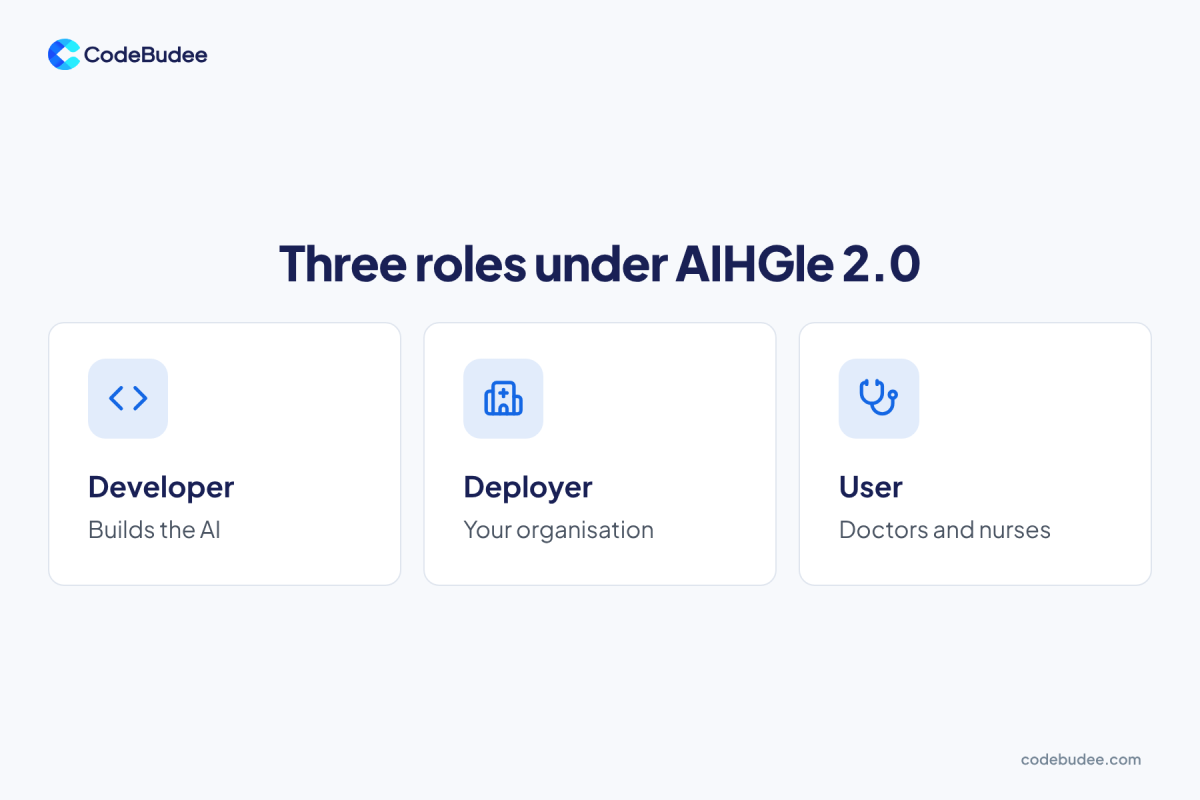
Yes. An offshore team can design, build and test healthcare AI for Singapore. What it cannot take from you is accountability. Singapore's updated AI in healthcare guidelines name three roles. The developer builds the AI, the deployer puts it to use, and the user works with it. Your organisation is the deployer.
Singapore's Ministry of Health and Health Sciences Authority launched these guidelines, called AIHGle 2.0, on 10 March 2026. The circular says AI should augment healthcare professionals, not replace them. HSA's digital health page lists the roles as developers, deployers (healthcare organisations) and users (healthcare professionals).
So an offshore team sits in the developer role. You still decide where the AI is used, who checks its output and when to switch it off. That is why hiring offshore is a design question first and a hiring question second.
Which rules decide what an offshore team can touch?
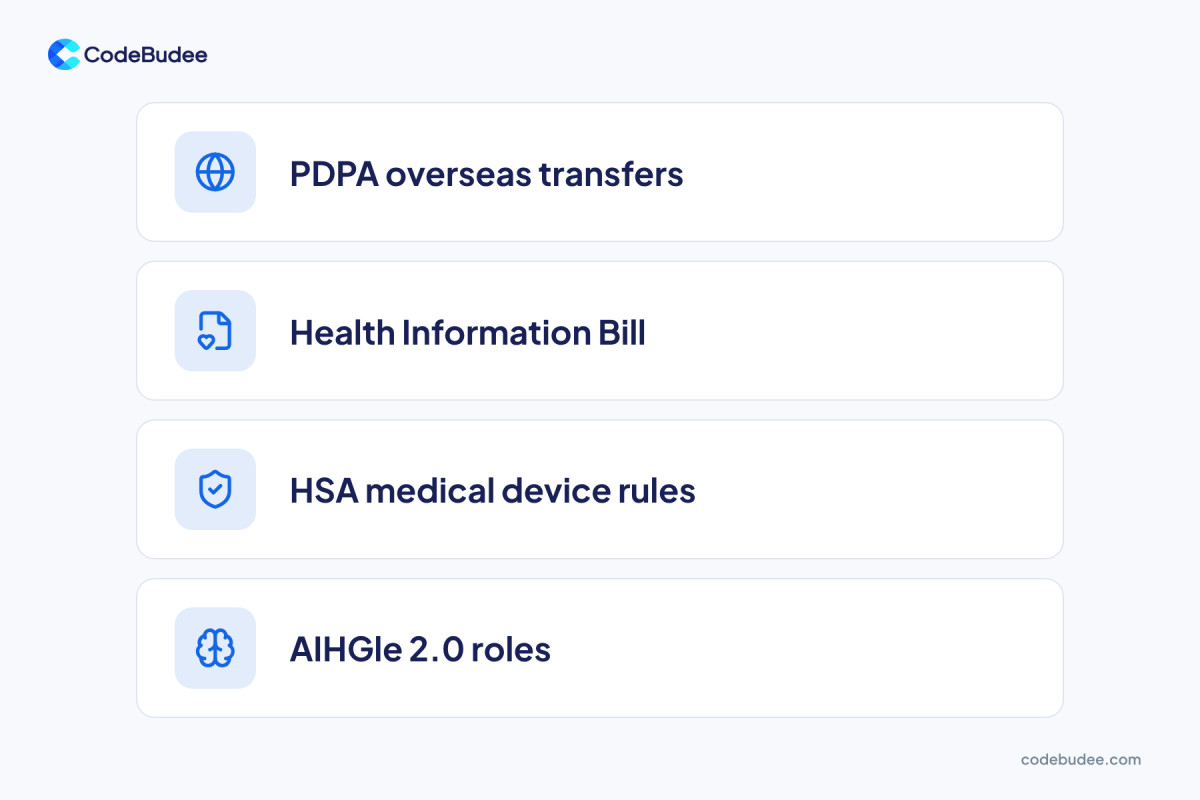
Four sets of Singapore rules shape what an offshore team may see and do. The PDPA controls personal data sent overseas. The Health Information Bill sets data security duties for providers. HSA rules apply when software is used for a medical purpose. AIHGle 2.0 sets out who is responsible for the AI.
Here is what each one means for your build:
- PDPA overseas transfers: section 26 says the receiver abroad must be bound to give protection comparable to Singapore law. A contract with the offshore firm is the usual way to do this.
- Health Information Bill: providers using the national record must meet data security rules, the Ministry of Health says. It is intended to take effect from early 2027.
- HSA medical device rules: software used for a medical purpose is classed as a medical device under HSA's controls. Check this before the build starts, not after.
- AIHGle 2.0: your organisation, as the deployer, decides how the AI is used and watched.
These rules are a design brief. They tell you where to draw the line in your system. A lawyer should confirm the details for your case.
What should stay with you, and what can go offshore?

Keep patient records, access keys and clinical sign-off with your own organisation. Let the offshore team work on the application and model code, using de-identified or test data. De-identified data has names and other details removed, so a record cannot easily be traced to a person. Draw this line before anyone writes code.
Our guide to AI data residency explains where business data goes when an AI tool runs. Here is a simple split for healthcare work:
- Stays with you: real patient records, production databases, encryption keys and the final clinical decision.
- The boundary: a pipeline you control that strips names and IDs before data leaves your systems.
- Offshore team: app features, model training on de-identified data, testing and code reviews.
- Shared: the code itself, kept in your own repository (the shared store where code lives) from the first commit.
Code ownership matters more than it looks. If the code sits in the vendor's account, you depend on them for every fix. When the code is yours, you can change teams without starting again.
What are the real risks of an offshore AI team?

The biggest risks are data leaks through the vendor and weak control over who can reach the AI. Breaches that involve an outside party are common, and AI systems are a newer target. In healthcare, each breach costs more than in any other industry studied.
Three numbers show why the boundary matters:
- Third parties: Verizon's 2025 Data Breach Investigations Report found third-party involvement doubled to 30% of breaches.
- Healthcare cost: IBM's 2025 Cost of a Data Breach report put the average healthcare breach at US$7.42 million. That was the highest of all industries studied.
- AI access: the same report found 13% of organisations reported breaches of AI models or applications. Of those, 97% had no AI access controls in place.
An offshore team is a third party by definition. Give it the least access it needs, log every login and remove access the day work ends. Our AI agent security controls cover the same idea for AI tools.
Offshore, local or a mix: which model fits?

Pick offshore when the work is well defined and needs no real patient data. Pick a local team when the work touches live clinical systems or changes often. A mix works for most healthcare AI. Local people own the data and decisions, and offshore people build to a clear brief.
Outsourcing is not going away. Deloitte's 2024 Global Outsourcing Survey found 80% of executives plan to maintain or increase investment in third-party outsourcing. The question is how to do it safely.
- Offshore: suits model work on de-identified data, test automation and features with a fixed scope.
- Local: suits work on live systems, links to the national record and anything needing quick clinical feedback.
- Mixed: suits most projects. One local lead owns the boundary and the code base.
Bottom line: if a task needs real patient data, keep it local. If it does not, it can go offshore. For more on picking a vendor, read our questions to ask an offshore partner.
How CodeBudee approaches this
We built Optom Pro Solutions, a multi-tenant SaaS electronic medical record and clinical platform for optometrists. Multi-tenant means one system can serve many clinics, each with its own data. Healthcare software is part of our work, and we have built for many industries.
You get a clear, itemised quote with no hidden costs. You own 100% of the source code, handed over at the end. You also talk directly to the person leading the build. Read more about our custom web app development.
Frequently asked questions
Can offshore developers access Singapore patient data?
They can only under strict conditions. The PDPA requires the receiver abroad to give protection comparable to Singapore law, usually through a contract. A safer design gives offshore developers de-identified or test data only. Real patient records stay in your own systems, and you control who can open them.
Who is accountable if offshore-built AI makes a mistake?
Your organisation stays accountable for how the AI is used. Under AIHGle 2.0, the developer builds the AI. The deployer, your healthcare organisation, decides how it is used and monitored. A contract can share some risk with the vendor. It cannot move your duty to patients.
Is an offshore AI team cheaper?
Often the day rate is lower, but the full cost depends on more than that. Rework, extra security work and slow feedback can eat the saving. Compare the total cost of the project, including support after launch, rather than the hourly rate alone. A mixed team is often the best balance.
Who should own the code an offshore team writes?
You should. Ask for the code to live in your own repository from day one, with full access for your team. Make ownership part of the contract. Then you can fix, extend or move the system without asking the original vendor for permission.
Your next step
Before you hire anyone, draw your data boundary. List what stays with you, what crosses as de-identified data and what the offshore team builds. Then choose the team that fits that line, not the other way round.
Book a free consultation to talk through your healthcare AI plan and where your data boundary should sit.