Your staff already paste emails into a public chatbot. Your competitor says they "use AI now". You start to wonder if your business is falling behind.
The data gives a calm answer. In 2026, 38% of Malaysian businesses use AI, and most of them use it in basic ways. This guide shows how Malaysian businesses use AI today and where they get stuck. It also shows how to move from a chatbot tab to AI inside your own systems.
Key takeaways
- 38% of Malaysian businesses used AI in 2026, up from 27% in 2025 and 20% in 2024.
- SMEs trail at 36%, while startups (58%) and large enterprises (55%) lead.
- Adopters see the most gains in customer service, data reports, and sales and marketing.
- 67% of businesses using AI stay at the basic stage: public chatbots and ready-made tools.
- Going further means one clear problem, clean data, connected systems and a named owner.
How many Malaysian businesses use AI in 2026?
About 38% of Malaysian businesses used AI in 2026, up from 27% a year earlier. Use is growing fast, but it is uneven. Startups and large enterprises lead, while SMEs sit below the national rate at 36%. Adoption is also strong in financial services and manufacturing.
These numbers come from the Unlocking Malaysia's AI Potential 2026 report. Strand Partners ran it for AWS and surveyed 1,000 Malaysian business leaders. It found that 58% of startups and 55% of large enterprises use AI. In financial services the figure is 53%, and in manufacturing it is 50%.
Growth has been steady. The 2025 edition of the same study found 27% of businesses using AI, up from 20% the year before.
So if your business does not use AI yet, you are not alone. Most Malaysian firms still don't. The bigger question is how well the users use it.
What are Malaysian businesses using AI for?
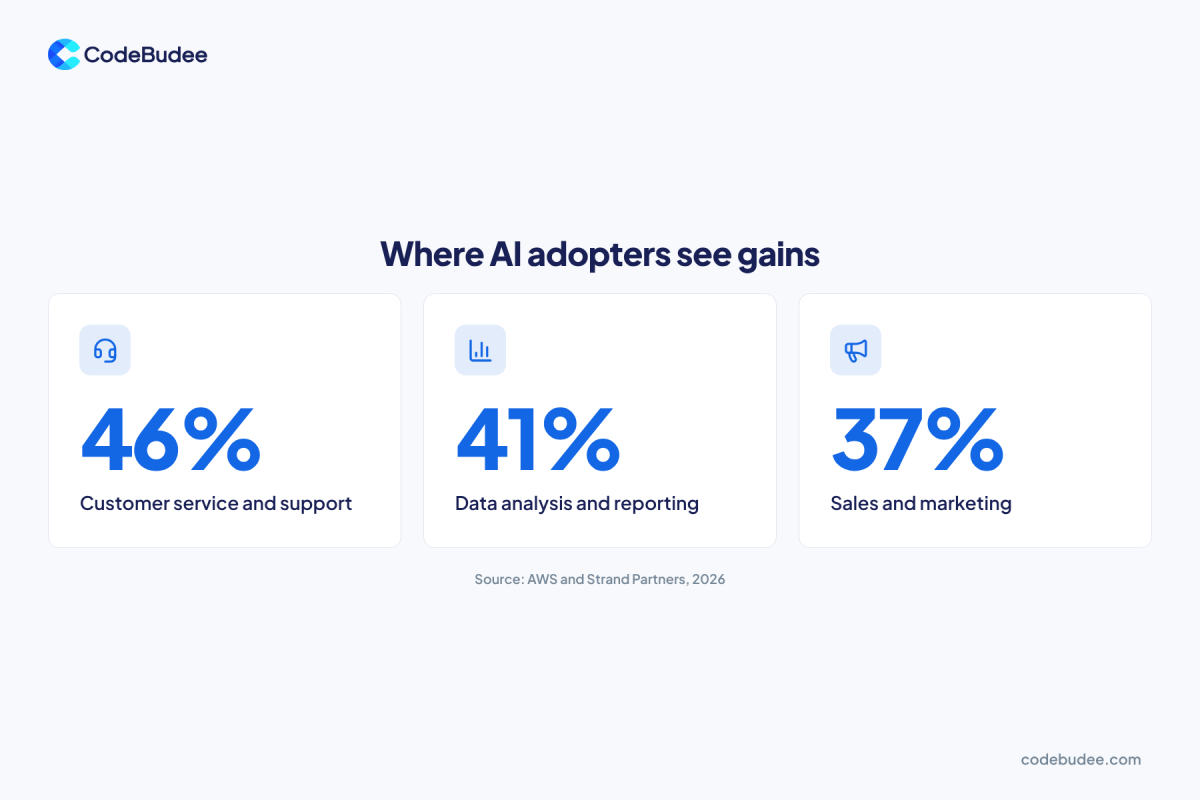
Businesses in Malaysia that use AI see the most gains in customer service, data reports and sales. Among AI adopters, 86% report better productivity. Gains show up most in customer service and support (46%) and data analysis and reporting (41%). Sales and marketing comes next (37%).
In daily work, that usually looks like this:
- Customer service: a chatbot answers common questions on the website or WhatsApp, day and night.
- Data and reports: staff ask AI to sum up sales figures or draft a monthly report.
- Sales and marketing: teams draft product copy, social posts and replies to leads.
Each of these saves time. But many run in a public chatbot, apart from your real systems. Staff copy data in, copy answers out, and check the result by hand.
Why does most AI use in Malaysia stay basic?

AI use in Malaysia mostly stays basic because few firms have a plan or the skills to go further. The 2026 study found 67% of AI users focus on basic uses, such as public chatbots for routine tasks. Only 13% build custom AI systems or use AI agents.
The study sorts AI users into three stages:
- Basic (67%): public chatbots and ready-made tools that make small gains in speed.
- Intermediate (20%): AI used across several teams, linked to how they work.
- Advanced (13%): custom AI systems, or several AI models (the engines behind AI tools) working together. Some use AI agents (software that acts by itself).
Several findings show why so many stop at stage one. Only 19% have a formal plan for using AI across more than one part of the business. Over half (53%) name staff skills as a barrier. And 33% say they lack a clear business case for spending more.
Control is thin too. Only 30% of businesses have clear owners for their AI work. A mere 18% have a written plan for when AI gets something wrong.
How do you move past basic AI use?
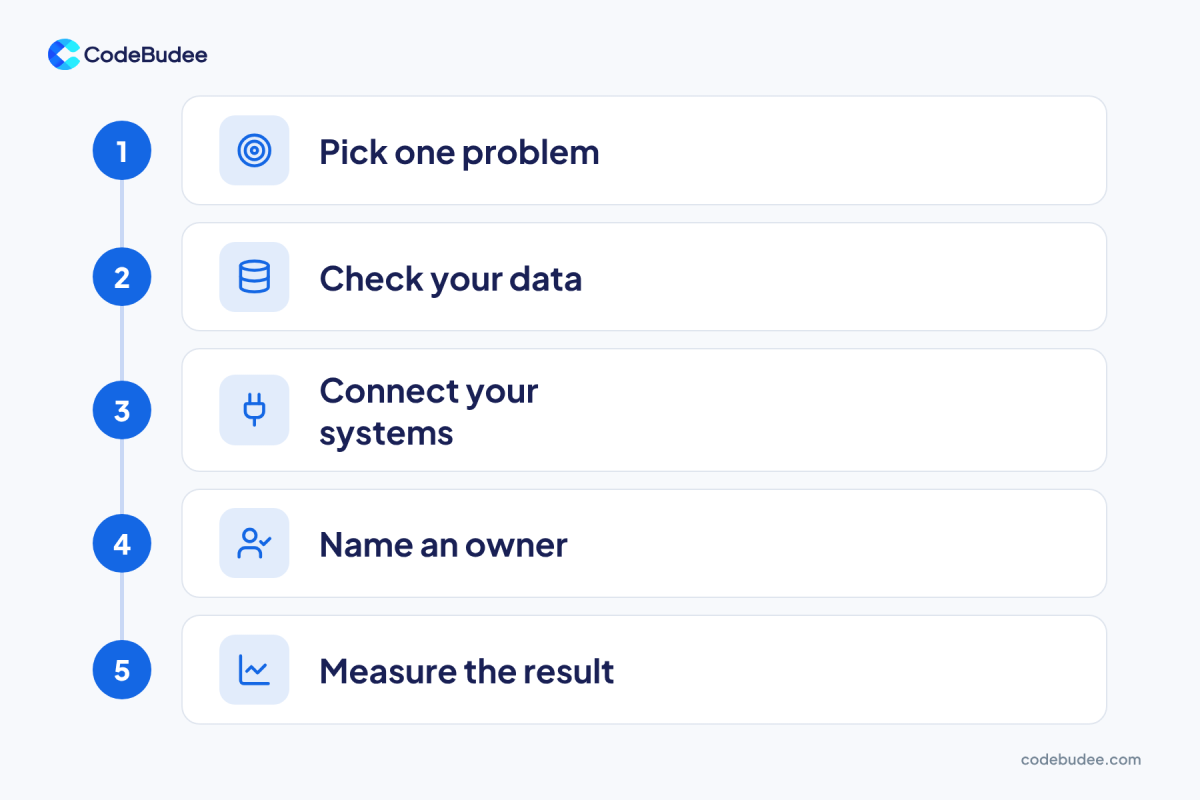
You move past basic AI use by starting from one costly problem, not from a tool. Then you clean the data and connect AI to the systems your staff already use. You also name someone to own it. Finally, you measure the result before you spread it to other teams.
Here are the five steps in order:
- Pick one problem: choose a job that costs real staff hours, such as replying to the same customer questions.
- Check your data: AI can only work with what your records hold. Our list of signs your data is not ready for AI helps here.
- Connect your systems: link AI to your booking, stock or customer records. Staff then stop copying data back and forth.
- Name an owner: one person decides what AI may do, checks its work and fixes mistakes.
- Measure the result: compare hours, errors or response times before and after.
Starting from a problem pays off. In the 2026 study, 46% of businesses said a specific business challenge drove their AI spending. Only 19% said they spent mainly to keep up with competitors.
For step 4, Malaysia has a guide you can follow. The National Guidelines on AI Governance and Ethics from MOSTI came out in September 2024. They are voluntary and set seven principles, including fairness, privacy and accountability.
Should you build AI in-house or use an outside team?
Outside teams are the usual way Malaysian businesses get AI. The 2026 study found 57% get AI mainly through outside providers, consultants or software vendors. Building in-house makes sense only when you already have developers and data skills. Without them, a partner is the usual route.
Firms with outside providers use them most for AI strategy (43%) and for linking and maintaining AI systems (40%). Next come model development (35%), staff training (31%) and compliance support (27%).
Use this rule to decide:
- In-house: you have your own developers, clean data, and AI is core to what you sell.
- Outside team: you need AI inside your own systems but have no developers to build and look after it.
- Mix: an outside team builds the first version, and your staff take over daily use.
Bottom line: keep the decisions in-house, and let a partner do the build and the links between systems. Our guide to choosing an AI development company in Malaysia lists the questions to ask a partner. To weigh the price, see what an AI agent costs to build and run.
When AI needs to live inside your booking, stock or customer records, that is a software job. It is where custom web app development comes in.
Frequently asked questions
What percentage of Malaysian businesses use AI?
About 38% of Malaysian businesses used AI in 2026, according to the AWS study by Strand Partners. That is up from 27% in 2025 and 20% in 2024. Use is highest among startups (58%) and large enterprises (55%). SMEs are slightly below the national rate at 36%.
Is it too late for my business to start using AI?
No. Most Malaysian businesses still do not use AI, and 67% of those that do use it in basic ways. A business that starts now with one clear problem can still move ahead of many competitors. The key is to plan how AI fits your work before you buy a tool.
Do I need my own AI model?
Usually not. Most businesses get good results from existing AI models connected to their own data and systems. Training your own model costs more and needs specialist skills. Our guide on getting your own AI agent compares the three ways to do it.
Are there AI rules in Malaysia?
Malaysia has the National Guidelines on AI Governance and Ethics, launched by MOSTI in September 2024. They are voluntary, not law. They set seven principles, including fairness, privacy and data security, transparency and accountability. Your existing data protection duties still apply when AI handles customer data.
Your next step
Malaysian businesses are using AI more each year, but most use stays at the chatbot stage. The firms that gain more start with one costly problem. They connect AI to their own systems and name someone to own it. Start by listing the jobs that eat the most staff hours each week.
Book a free consultation to talk through where AI could fit into your systems and what it would take.